用大模型从文本生成高质量知识图谱,解决数据稀缺问题
KGGen: Extracting Knowledge Graphs from Plain Text with Language Models
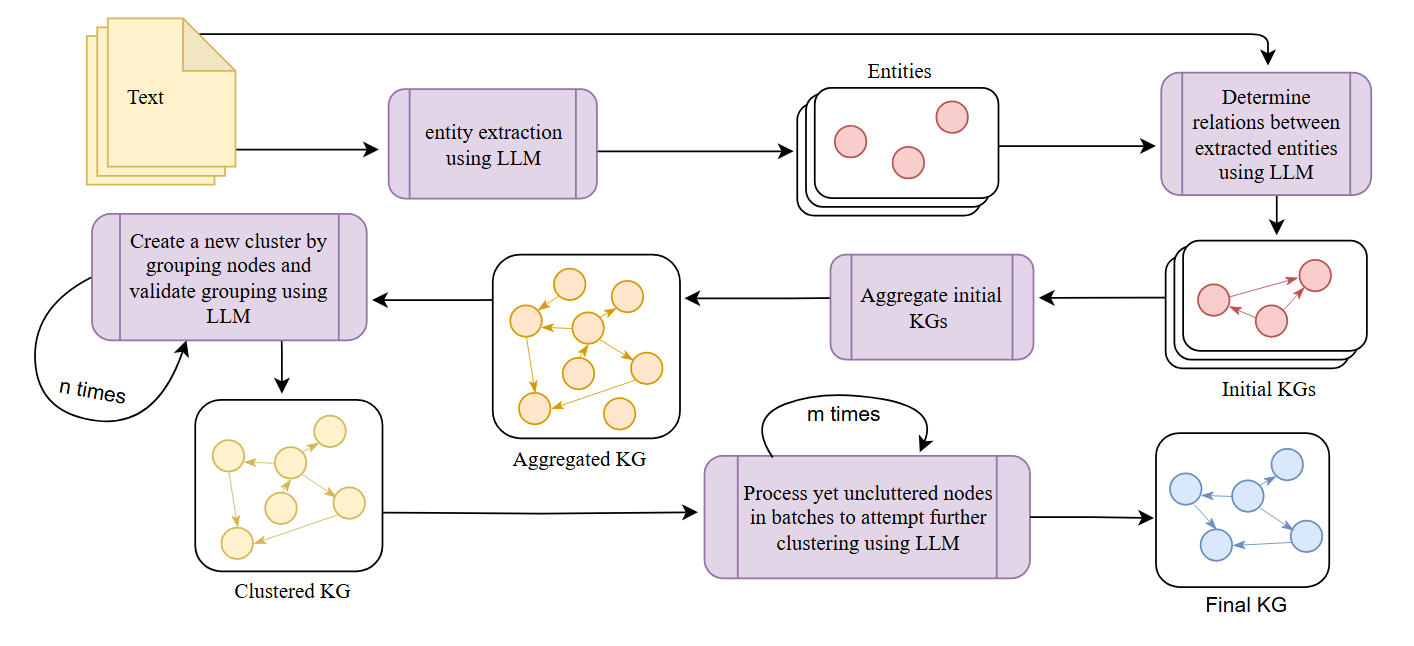
- 用语言模型生成知识图谱,通过实体聚类减少稀疏性
- 在新基准MINE上性能显著优于现有工具
- 开源为Python库,适合研究者和开发者快速构建图谱
近年来,构建知识图谱基础模型引发了对知识图谱数据稀缺性的关注。当前主流知识图谱多依赖人工标注、模式匹配或早期NLP技术提取,人工标注资源有限,自动提取结果质量参差。我们提出KGGen——一种文本到知识图谱的生成工具,利用语言模型从纯文本中生成高质量图谱。不同于传统提取器,KGGen通过聚类相关实体来降低图谱稀疏性。该工具已作为Python库发布(pip install kg-gen),便于广泛使用。同时,我们构建首个评估基准MINE(Measure of Information in Nodes and Edges),用于测试提取器从文本生成有用图谱的能力。在该基准上,KGGen表现远超现有方法。
原文摘要 · Abstract (English)
Recent interest in building foundation models for KGs has highlighted a fundamental challenge: knowledge-graph data is relatively scarce. The best-known KGs are primarily human-labeled, created by pattern-matching, or extracted using early NLP techniques. While human-generated KGs are in short supply, automatically extracted KGs are of questionable quality. We present a solution to this data scarcity problem in the form of a text-to-KG generator (KGGen), a package that uses language models to create high-quality graphs from plaintext. Unlike other KG extractors, KGGen clusters related entities to reduce sparsity in extracted KGs. KGGen is available as a Python library (\texttt{pip install kg-gen}), making it accessible to everyone. Along with KGGen, we release the first benchmark, Measure of of Information in Nodes and Edges (MINE), that tests an extractor's ability to produce a useful KG from plain text. We benchmark our new tool against existing extractors and demonstrate far superior performance.
Thank you to arXiv for use of its open access interoperability. PaperDance 不是 arXiv 官方产品;中文卡片由大模型生成,请以原文为准。