用模块化运动基元实现更类人的机器人控制。
Modular Robot Control with Motor Primitives
- 基于运动基元构建模块化控制框架,实现独立与稳定闭环。
- 无需逆运动学即可完成任务空间控制,解决奇异性与冗余问题。
- 适合需要物理交互的复杂任务,尤其在高负载场景表现优异。
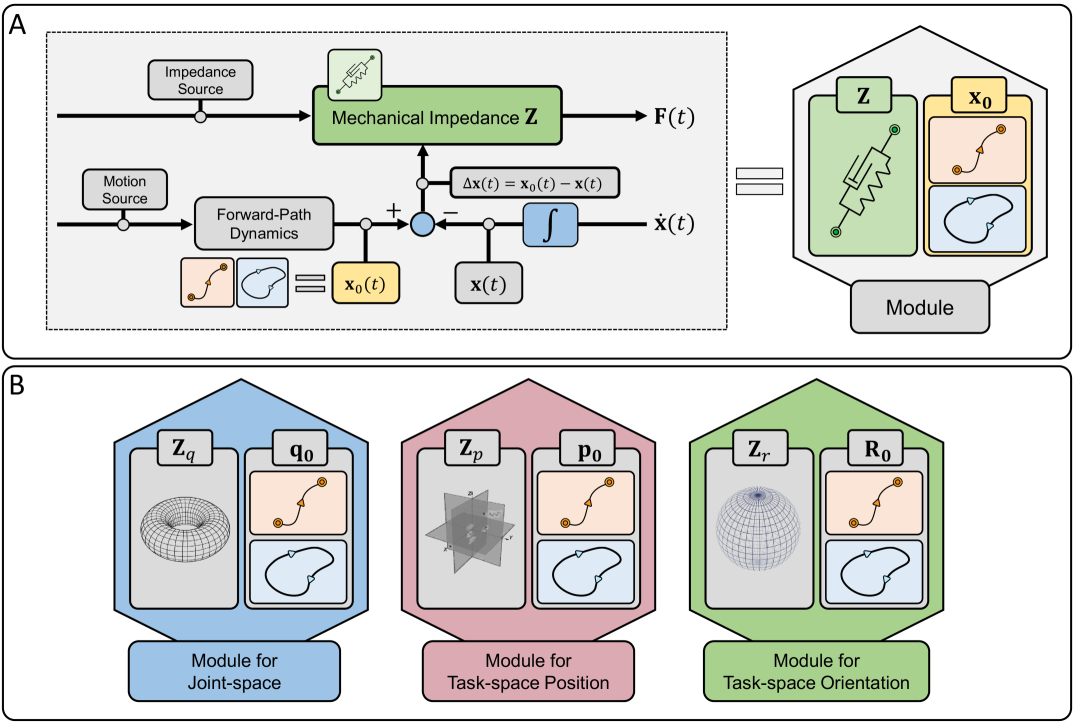
尽管人类的神经肌肉系统响应较慢,但在涉及物理接触的任务中仍远超现代机器人技术。生物证据表明,生物体的运动控制依赖于运动基元的模块化组织,这些基元是运动行为的基本单元。受神经运动控制研究启发,使用简化构建块的方法已在机器人领域取得成功。然而,机器人控制的模块化尚未形成完整理论体系。本文提出一种基于运动基元的模块化控制框架,明确两个关键要求:模块独立性与稳定性闭包。通过定义若干核心控制模块,证明仅用少量模块及其组合即可生成多种复杂机器人行为。该框架具备多项优势:无需求解逆运动学即可实现任务空间控制,有效应对运动学奇异性与冗余问题,并保持接触交互中的无源性。此外,可利用运动学奇异性以低扭矩补偿维持高外部负载,甚至可控制末端以外的物体。仿真与实际机器人实验验证了框架的有效性。结论表明,模块化可能是实现接近人类水平机器人性能的可行构造范式。
原文摘要 · Abstract (English)
Despite a slow neuromuscular system, humans easily outperform modern robot technology, especially in physical contact tasks. How is this possible? Biological evidence indicates that motor control of biological systems is achieved by a modular organization of motor primitives, which are fundamental building blocks of motor behavior. Inspired by neuro-motor control research, the idea of using simpler building blocks has been successfully used in robotics. Nevertheless, a comprehensive formulation of modularity for robot control remains to be established. In this paper, we introduce a modular framework for robot control using motor primitives. We present two essential requirements to achieve modular robot control: independence of modules and closure of stability. We describe key control modules and demonstrate that a wide range of complex robotic behaviors can be generated from this small set of modules and their combinations. The presented modular control framework demonstrates several beneficial properties for robot control, including task-space control without solving Inverse Kinematics, addressing the problems of kinematic singularity and kinematic redundancy, and preserving passivity for contact and physical interactions. Further advantages include exploiting kinematic singularity to maintain high external load with low torque compensation, as well as controlling the robot beyond its end-effector, extending even to external objects. Both simulation and actual robot experiments are presented to validate the effectiveness of our modular framework. We conclude that modularity may be an effective constructive framework for achieving robotic behaviors comparable to human-level performance.
Thank you to arXiv for use of its open access interoperability. PaperDance 不是 arXiv 官方产品;中文卡片由大模型生成,请以原文为准。