仅用无配对数据就能学出跨模态通用表示,效果媲美有配对数据。
Learning Shared Representations from Unpaired Data
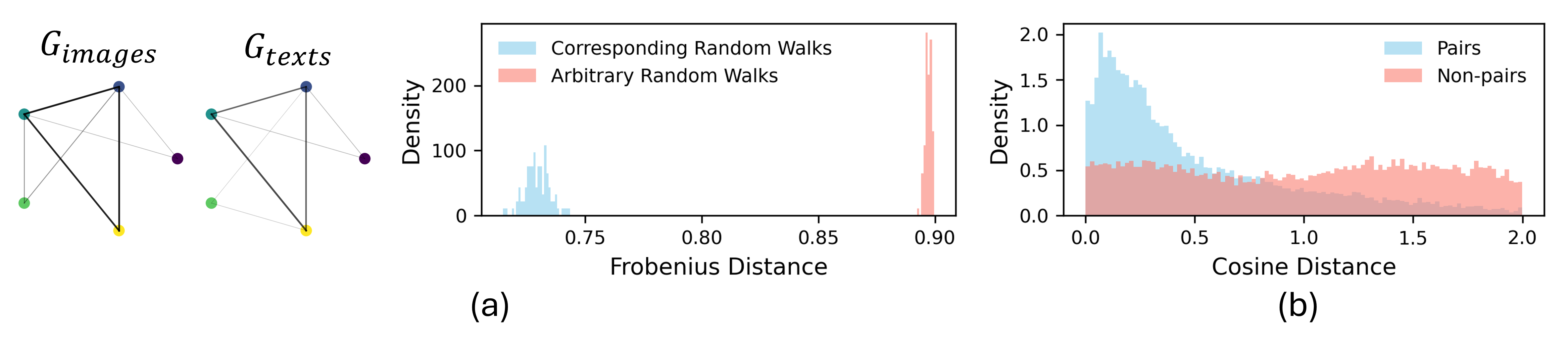
- 基于单模态随机游走矩阵的谱嵌入,无需配对样本即可建模跨模态关系。
- 在图像与文本任务中实现高精度检索、生成、零样本分类等,性能接近有配对数据方法。
- 适合缺乏标注配对数据的场景,如多模态知识迁移、跨域理解等研究者使用。
学习共享表示是多模态表示学习的核心方向。现有方法严重依赖各模态间的配对样本,而这类数据远难获取。本文证明:共享表示可几乎完全从无配对数据中学习。方法基于从各单模态表示独立构建的随机游走矩阵的谱嵌入。计算机视觉与自然语言处理领域的实验验证其有效性,展现出在检索、生成、算术运算、零样本及跨域分类任务中的强大能力。据我们所知,这是首个几乎仅依赖无配对样本实现此类性能的工作,构建出可视为通用的跨模态嵌入,不依赖具体数据模态。项目页:https://shaham-lab.github.io/SUE_page。
原文摘要 · Abstract (English)
Learning shared representations is a primary area of multimodal representation learning. The current approaches to achieve a shared embedding space rely heavily on paired samples from each modality, which are significantly harder to obtain than unpaired ones. In this work, we demonstrate that shared representations can be learned almost exclusively from unpaired data. Our arguments are grounded in the spectral embeddings of the random walk matrices constructed independently from each unimodal representation. Empirical results in computer vision and natural language processing domains support its potential, revealing the effectiveness of unpaired data in capturing meaningful cross-modal relations, demonstrating high capabilities in retrieval tasks, generation, arithmetics, zero-shot, and cross-domain classification. This work, to the best of our knowledge, is the first to demonstrate these capabilities almost exclusively from unpaired samples, giving rise to a cross-modal embedding that could be viewed as universal, i.e., independent of the specific modalities of the data. Our project page: https://shaham-lab.github.io/SUE_page.
Thank you to arXiv for use of its open access interoperability. PaperDance 不是 arXiv 官方产品;中文卡片由大模型生成,请以原文为准。