探索能自主完成复杂研究任务的智能体系统,梳理技术架构与未来方向。
Deep Research Agents: A Systematic Examination And Roadmap
- 构建多步推理与动态规划的智能体框架,支持工具迭代与信息检索。
- 提出静态/动态工作流分类体系,区分单智能体与多智能体架构。
- 揭示现有评测短板,适合研究自主智能体与信息处理的开发者参考。
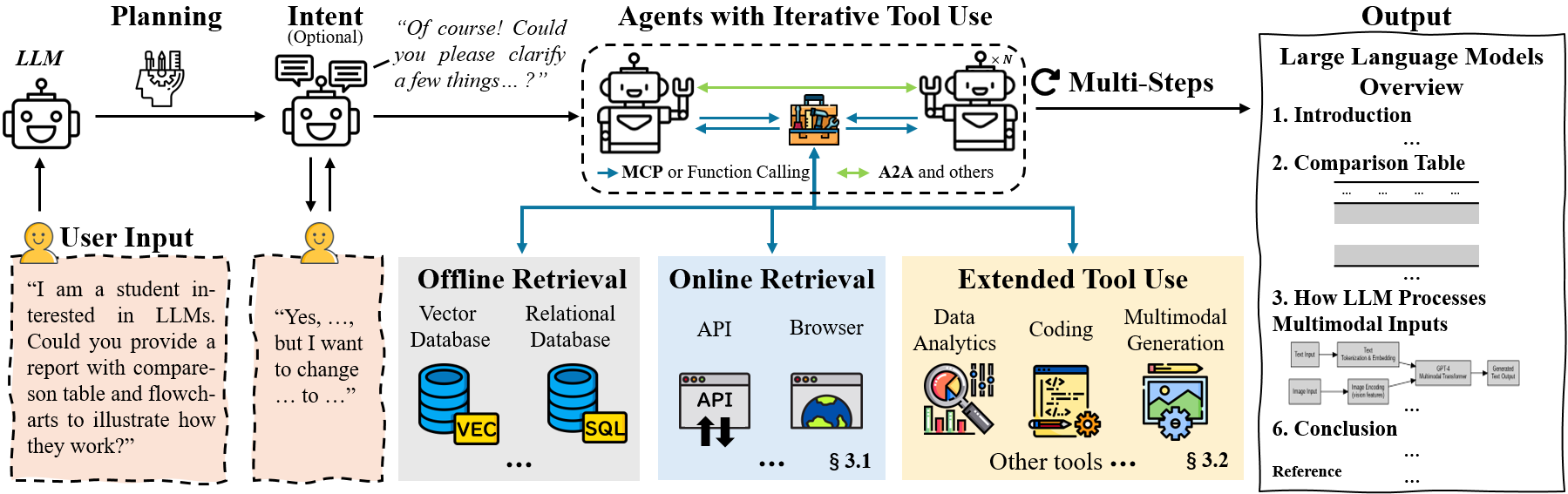
大型语言模型(LLMs)的快速发展催生了一类新型自主AI系统——深度研究(Deep Research, DR)智能体。这类智能体通过动态推理、自适应长程规划、多跳信息检索、迭代工具调用及结构化报告生成,应对复杂的多轮信息研究任务。本文系统分析了构成DR智能体的基础技术与架构组件:首先对比基于API与基于浏览器的信息获取策略;接着考察模块化工具使用框架,包括代码执行、多模态输入处理以及模型上下文协议(MCPs)以支持可扩展性与生态建设。为统整现有方法,提出工作流分类(静态/动态)与基于规划策略和智能体组成(单/多智能体)的架构分类体系。同时批判性评估当前基准,指出外部知识访问受限、顺序执行效率低及评价指标与实际目标不匹配等关键缺陷。最后,展望开放挑战与未来研究方向。相关研究资源持续更新,详见:https://github.com/ai-agents-2030/awesome-deep-research-agent。
原文摘要 · Abstract (English)
The rapid progress of Large Language Models (LLMs) has given rise to a new category of autonomous AI systems, referred to as Deep Research (DR) agents. These agents are designed to tackle complex, multi-turn informational research tasks by leveraging a combination of dynamic reasoning, adaptive long-horizon planning, multi-hop information retrieval, iterative tool use, and the generation of structured analytical reports. In this paper, we conduct a detailed analysis of the foundational technologies and architectural components that constitute Deep Research agents. We begin by reviewing information acquisition strategies, contrasting API-based retrieval methods with browser-based exploration. We then examine modular tool-use frameworks, including code execution, multimodal input processing, and the integration of Model Context Protocols (MCPs) to support extensibility and ecosystem development. To systematize existing approaches, we propose a taxonomy that differentiates between static and dynamic workflows, and we classify agent architectures based on planning strategies and agent composition, including single-agent and multi-agent configurations. We also provide a critical evaluation of current benchmarks, highlighting key limitations such as restricted access to external knowledge, sequential execution inefficiencies, and misalignment between evaluation metrics and the practical objectives of DR agents. Finally, we outline open challenges and promising directions for future research. A curated and continuously updated repository of DR agent research is available at: {https://github.com/ai-agents-2030/awesome-deep-research-agent}.
Thank you to arXiv for use of its open access interoperability. PaperDance 不是 arXiv 官方产品;中文卡片由大模型生成,请以原文为准。