用元学习方法解决因果图不确定下的干预效果估计问题
Estimating Interventional Distributions with Uncertain Causal Graphs through Meta-Learning
- 通过元学习构建可端到端训练的因果估计模型
- 在多因果图共存场景下表现优于传统贝叶斯基线
- 适合需要处理结构不确定性的复杂因果推断任务
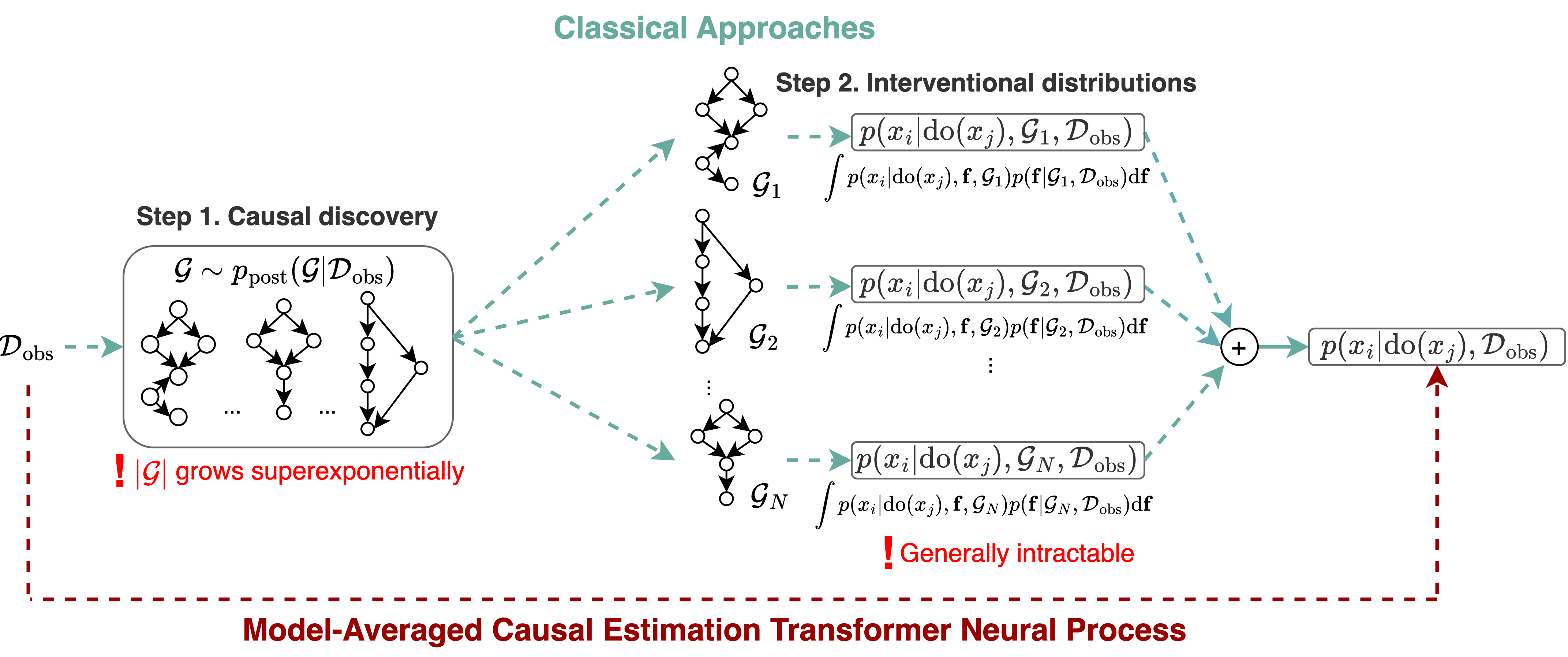
在生物、社会科学等科学领域,许多问题本质上是:对某一变量进行干预后会观察到什么结果?若已知因果关系(如因果图),可估计干预分布。但当缺乏先验知识时,需从观测数据中发现因果结构。然而,观测数据常对应多个可能的因果图,导致依赖单一结构的方法容易过度自信。一种合理方式是使用贝叶斯推断,对可能的因果结构和函数机制进行后验平均。但因果结构数量随节点数呈超指数增长,计算上不可行。本文提出元学习框架MACE-TNP——模型平均因果估计变换器神经过程,训练其直接预测贝叶斯模型平均的干预后验分布,避免昂贵计算。实验证明,MACE-TNP显著优于强基准方法。该工作确立了元学习作为灵活且可扩展的贝叶斯因果推断近似范式,未来可应用于更复杂的因果分析场景。
原文摘要 · Abstract (English)
In scientific domains -- from biology to the social sciences -- many questions boil down to \textit{What effect will we observe if we intervene on a particular variable?} If the causal relationships (e.g.~a causal graph) are known, it is possible to estimate the intervention distributions. In the absence of this domain knowledge, the causal structure must be discovered from the available observational data. However, observational data are often compatible with multiple causal graphs, making methods that commit to a single structure prone to overconfidence. A principled way to manage this structural uncertainty is via Bayesian inference, which averages over a posterior distribution on possible causal structures and functional mechanisms. Unfortunately, the number of causal structures grows super-exponentially with the number of nodes in the graph, making computations intractable. We propose to circumvent these challenges by using meta-learning to create an end-to-end model: the Model-Averaged Causal Estimation Transformer Neural Process (MACE-TNP). The model is trained to predict the Bayesian model-averaged interventional posterior distribution, and its end-to-end nature bypasses the need for expensive calculations. Empirically, we demonstrate that MACE-TNP outperforms strong Bayesian baselines. Our work establishes meta-learning as a flexible and scalable paradigm for approximating complex Bayesian causal inference, that can be scaled to increasingly challenging settings in the future.
Thank you to arXiv for use of its open access interoperability. PaperDance 不是 arXiv 官方产品;中文卡片由大模型生成,请以原文为准。