解决情绪识别中多维标签缺失问题,提升脑电特征选择鲁棒性。
REFS: Robust EEG feature selection with missing multi-dimensional annotation for emotion recognition
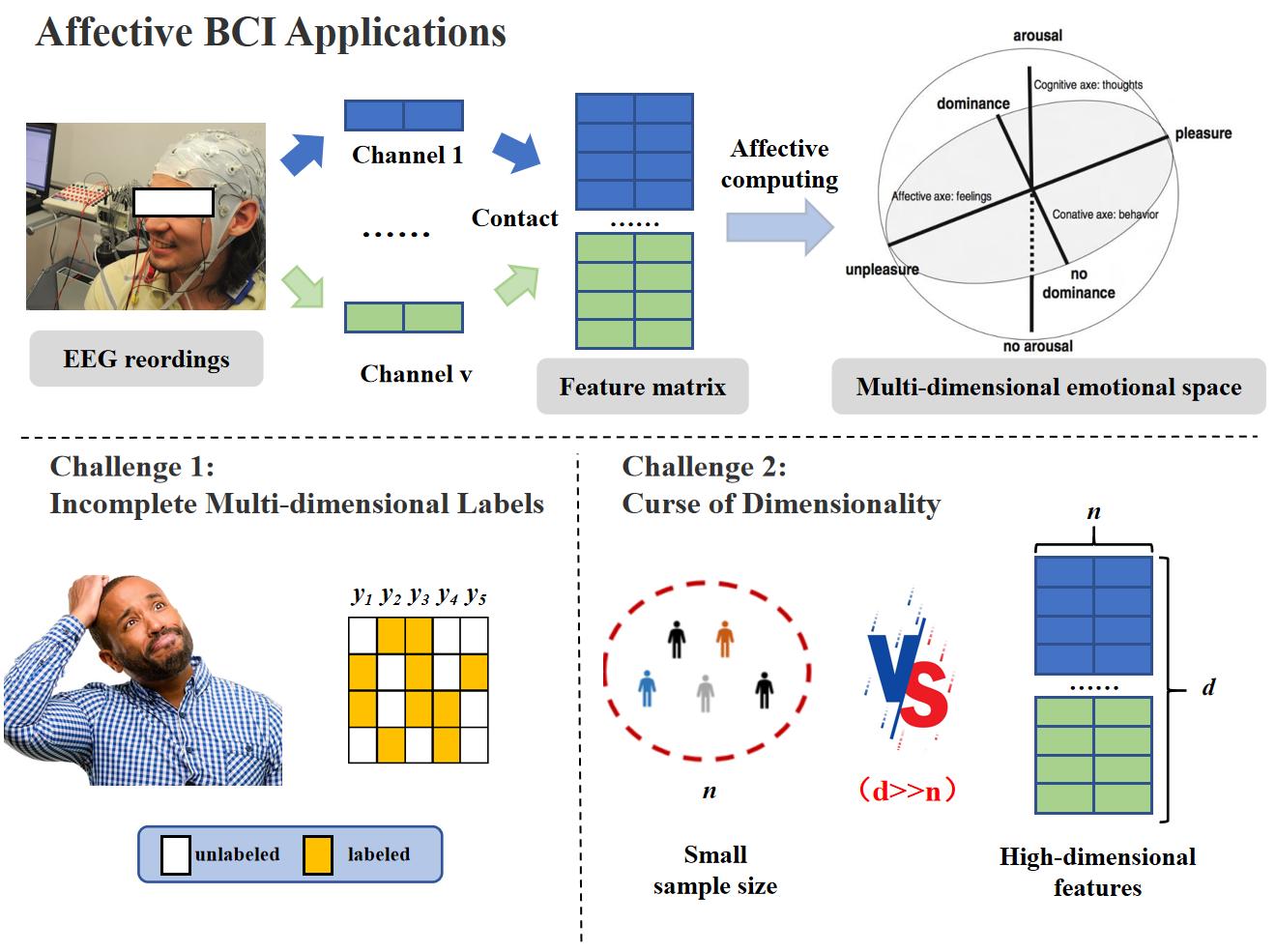
- 利用高阶相关性重建缺失情绪标签空间,减少异常值影响。
- 结合图正则与冗余最小化,在标签缺失下选出最优脑电特征子集。
- 在三个公开数据集上优于13种主流方法,适合真实场景情绪识别。
情感脑机接口是人机交互中情感智能的关键技术,近年来受到广泛关注。相较于单一特征,多类型脑电(EEG)特征能提供多维度情绪的多层次表征。然而,多类型EEG特征的高维性与高质量样本数量有限,导致分类器过拟合及实时性能不佳。此外,实际应用中因采集环境开放、个体情绪感知差异,常出现多维情绪标签部分缺失。为此,本文提出一种针对缺失多维情绪标签的新型脑电特征选择方法。该方法利用自适应正交非负矩阵分解,通过二阶及以上高阶相关性重建情绪标签空间,降低缺失值与异常值的影响;同时结合基于图的流形学习正则与全局特征冗余最小化正则的最小二乘回归,实现标签缺失下的脑电特征子集选择,最终达成鲁棒的多维情绪识别。在DREAMER、DEAP和HDED三个常用多维情绪数据集上的仿真实验表明,所提方法在脑电情感特征选择的鲁棒性上优于13种先进方法。
原文摘要 · Abstract (English)
The affective brain-computer interface is a crucial technology for affective interaction and emotional intelligence, emerging as a significant area of research in the human-computer interaction. Compared to single-type features, multi-type EEG features provide a multi-level representation for analyzing multi-dimensional emotions. However, the high dimensionality of multi-type EEG features, combined with the relatively small number of high-quality EEG samples, poses challenges such as classifier overfitting and suboptimal real-time performance in multi-dimensional emotion recognition. Moreover, practical applications of affective brain-computer interface frequently encounters partial absence of multi-dimensional emotional labels due to the open nature of the acquisition environment, and ambiguity and variability in individual emotion perception. To address these challenges, this study proposes a novel EEG feature selection method for missing multi-dimensional emotion recognition. The method leverages adaptive orthogonal non-negative matrix factorization to reconstruct the multi-dimensional emotional label space through second-order and higher-order correlations, which could reduce the negative impact of missing values and outliers on label reconstruction. Simultaneously, it employs least squares regression with graph-based manifold learning regularization and global feature redundancy minimization regularization to enable EEG feature subset selection despite missing information, ultimately achieving robust EEG-based multi-dimensional emotion recognition. Simulation experiments on three widely used multi-dimensional emotional datasets, DREAMER, DEAP and HDED, reveal that the proposed method outperforms thirteen advanced feature selection methods in terms of robustness for EEG emotional feature selection.
Thank you to arXiv for use of its open access interoperability. PaperDance 不是 arXiv 官方产品;中文卡片由大模型生成,请以原文为准。