用投影光栅实时检测激光增材制造的层间缺陷,精度达±46μm。
Layer-Wise Anomaly Detection in Directed Energy Deposition using High-Fidelity Fringe Projection Profilometry
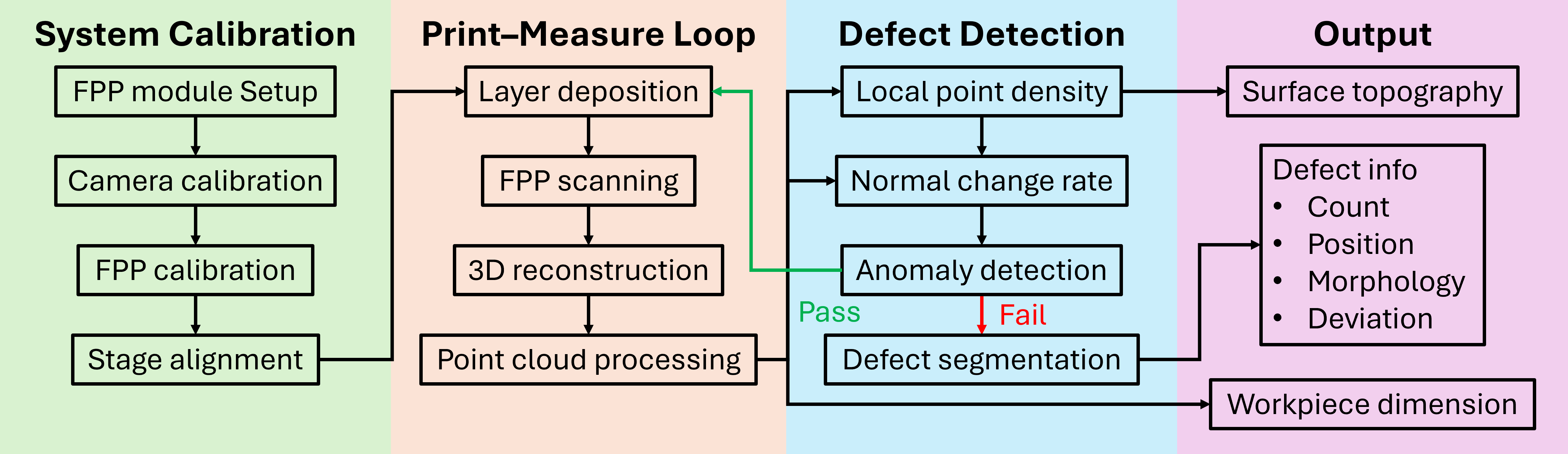
- 通过同步扫描重建每层表面三维形貌,实现无标注自动检测。
- 定位精度±46μm,识别出表面粗糙与未熔合等常见缺陷。
- 适合需要高精度过程监控的金属3D打印领域应用。
定向能量沉积(DED)是一种金属增材制造工艺,易产生几何偏差、未熔合和表面质量差等缺陷。本文提出一种与成形高度同步的高保真光栅投影系统,实现了对激光DED构件的原位层间表面重建,重建精度达±46 μm。基于重建的三维形貌,引入两种互补的几何点云度量:局部点密度用于突出表面粗糙问题,法向变化率用于识别未熔合特征。该方法可直接从重建表面自动、无需标注地识别常见沉积缺陷,不依赖人工标记。通过将几何偏差与缺陷形成直接关联,实现缺陷的精准定位,提升了闭环工艺控制的可行性。本工作确立了光栅投影在微米级监测中的实用性,弥合了工艺信号与零件几何之间的差距,推动可认证增材制造的发展。
原文摘要 · Abstract (English)
Directed energy deposition (DED), a metal additive manufacturing process, is highly susceptible to process-induced defects such as geometric deviations, lack of fusion, and poor surface finish. This work presents a build-height-synchronized fringe projection system for in-situ, layer-wise surface reconstruction of laser-DED components, achieving a reconstruction accuracy of ${\pm}$46 $μ$m. From the reconstructed 3D morphology, two complementary geometry-based point cloud metrics are introduced: local point density, which highlights poor surface finish, and normal-change rate, which identifies lack-of-fusion features. These methods enable automated, annotation-free identification of common deposition anomalies directly from reconstructed surfaces, without the need for manual labeling. By directly linking geometric deviation to defect formation, the approach enables precise anomaly localization and advances the feasibility of closed-loop process control. This work establishes fringe projection as a practical tool for micrometer-scale monitoring in DED, bridging the gap between process signatures and part geometry for certifiable additive manufacturing.
Thank you to arXiv for use of its open access interoperability. PaperDance 不是 arXiv 官方产品;中文卡片由大模型生成,请以原文为准。