针对表格数据极端不平衡回归,提出新方法提升罕见事件预测精度。
Highly Imbalanced Regression with Tabular Data in SEP and Other Applications
- 引入相关性感知损失与单调递减逆卷积重要性函数
- 在五个数据集上误差更低,罕见样本预测相关性提升显著
- 适合高风险场景如太阳粒子事件预测,对模型改进有普适价值
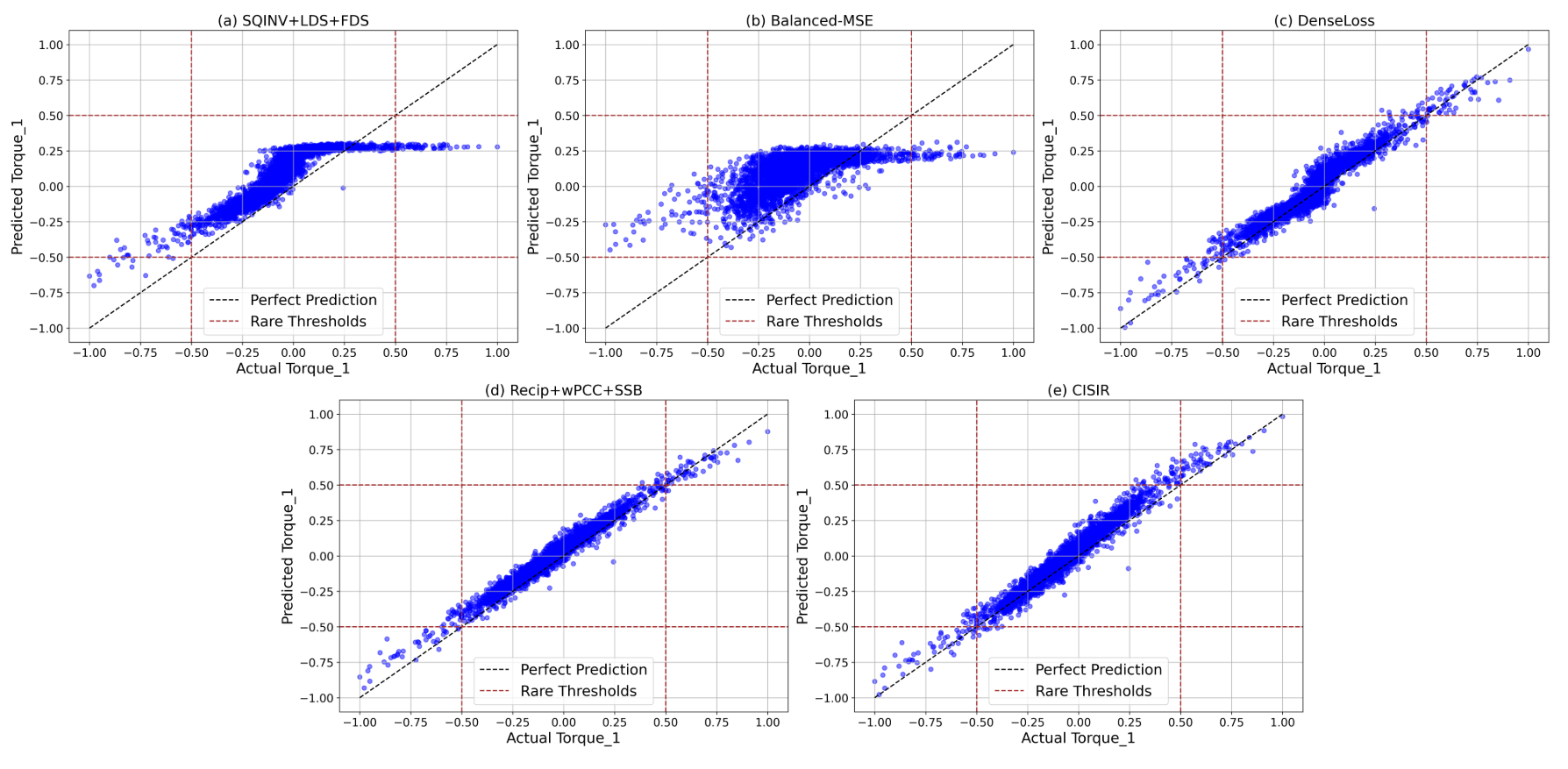
我们研究了不平衡比率超过1000的表格数据极端不平衡回归问题。准确估计罕见实例的目标值在预测稀有有害太阳高能粒子(SEP)事件强度等应用中至关重要。传统均方误差损失不考虑预测值与真实值间的相关性;典型逆重要性函数仅支持凸函数;均匀采样可能导致小批量中无罕见样本。本文提出CISIR方法,融合相关性建模、单调递减逆卷积(MDI)重要性函数和分层采样策略。基于五个数据集的实验表明,CISIR在误差和相关性上优于部分近期方法;将我们的相关性组件加入其他方法可进一步提升性能。此外,MDI重要性函数表现优于其他类型。代码已开源:https://github.com/Machine-Earning/CISIR。
原文摘要 · Abstract (English)
We investigate imbalanced regression with tabular data that have an imbalance ratio larger than 1,000 ("highly imbalanced"). Accurately estimating the target values of rare instances is important in applications such as forecasting the intensity of rare harmful Solar Energetic Particle (SEP) events. For regression, the MSE loss does not consider the correlation between predicted and actual values. Typical inverse importance functions allow only convex functions. Uniform sampling might yield mini-batches that do not have rare instances. We propose CISIR that incorporates correlation, Monotonically Decreasing Involution (MDI) importance, and stratified sampling. Based on five datasets, our experimental results indicate that CISIR can achieve lower error and higher correlation than some recent methods. Also, adding our correlation component to other recent methods can improve their performance. Lastly, MDI importance can outperform other importance functions. Our code can be found in https://github.com/Machine-Earning/CISIR.
Thank you to arXiv for use of its open access interoperability. PaperDance 不是 arXiv 官方产品;中文卡片由大模型生成,请以原文为准。