用量子启发模型更准预测神经元放电时间。
Stimulus-Voltage-Based Prediction of Action Potential Onset Timing: Classical vs. Quantum-Inspired Approaches
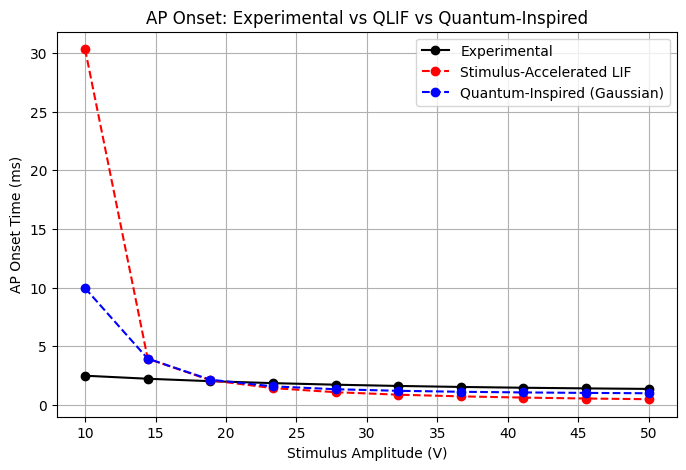
- 将放电时机建模为时间上的高斯波包,引入概率机制。
- 在强刺激下误差显著降低,逼近真实生物反应。
- 适合脑科学与类脑计算研究者参考。
准确建模神经元动作电位(AP)的起始时间对于理解危险信号的神经编码至关重要。传统漏斗积分-发放(LIF)模型虽广泛使用,但在强或快速变化的刺激下预测放电潜伏期时相对误差较高。受近期实验发现和量子理论启发,我们提出一种量子启发漏斗积分-发放(QI-LIF)模型,将放电起始视为概率事件,并以时间上的高斯波包表示。该方法捕捉了神经元放电固有的生物变异性与不确定性。我们系统比较了经典LIF与QI-LIF模型在海马神经元和感觉神经元合成数据上的放电起始预测相对误差,结果表明:在高强度刺激下,QI-LIF模型显著降低预测误差,与观察到的生物反应高度一致。本工作凸显了量子启发计算框架在提升神经建模精度方面的潜力,对类脑计算中的量子工程方法具有启示意义。
原文摘要 · Abstract (English)
Accurate modeling of neuronal action potential (AP) onset timing is crucial for understanding neural coding of danger signals. Traditional leaky integrate-and-fire (LIF) models, while widely used, exhibit high relative error in predicting AP onset latency, especially under strong or rapidly changing stimuli. Inspired by recent experimental findings and quantum theory, we present a quantum-inspired leaky integrate-and-fire (QI-LIF) model that treats AP onset as a probabilistic event, represented by a Gaussian wave packet in time. This approach captures the biological variability and uncertainty inherent in neuronal firing. We systematically compare the relative error of AP onset predictions between the classical LIF and QI-LIF models using synthetic data from hippocampal and sensory neurons subjected to varying stimulus amplitudes. Our results demonstrate that the QI-LIF model significantly reduces prediction error, particularly for high-intensity stimuli, aligning closely with observed biological responses. This work highlights the potential of quantum-inspired computational frameworks in advancing the accuracy of neural modeling and has implications for quantum engineering approaches to brain-inspired computing.
Thank you to arXiv for use of its open access interoperability. PaperDance 不是 arXiv 官方产品;中文卡片由大模型生成,请以原文为准。