用注意力机制提升眼底图像动静脉分割精度
Artery-Vein Segmentation from Fundus Images using Deep Learning
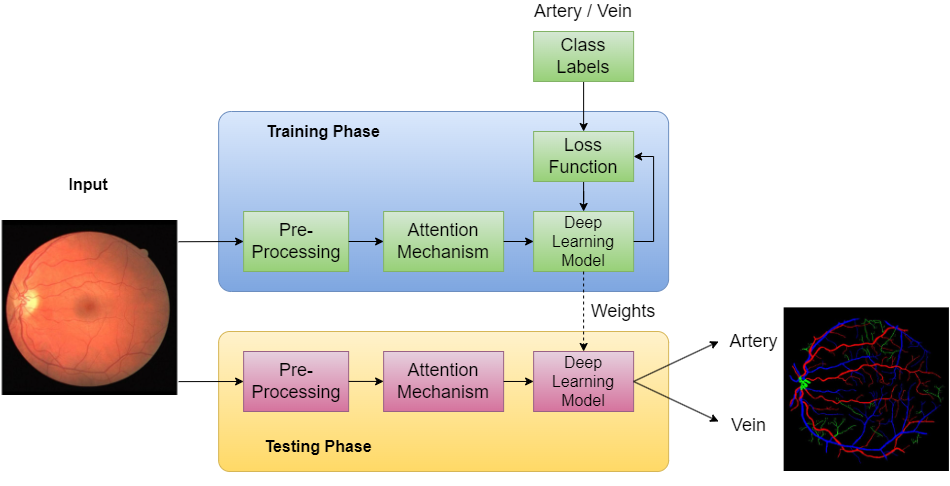
- 在WNet中引入注意力机制,增强血管特征捕捉能力
- 在HRF和DRIVE数据集上达到当前最优分割性能
- 适合眼科疾病早期诊断与血管健康评估研究者使用
将临床重要的视网膜血管区分为动脉和静脉是视网膜血管分析的前提。此类分析可为多种视网膜眼病的识别与诊断提供潜在洞察与生物标志物。视网膜血管规律性与宽度的变化可反映全身血管系统的健康状况,有助于识别卒中和心肌梗死等血管疾病高风险患者。近年来,已有多种深度学习架构用于视网膜血管分割。近期,注意力机制在图像分割任务中应用日益广泛。本文提出一种新的深度学习方法用于动静脉分割,该方法基于将注意力机制融入WNet深度学习模型,命名为Attention-WNet。所提方法在公开数据集HRF和DRIVE上进行了测试,性能优于文献中其他先进模型。
原文摘要 · Abstract (English)
Segmenting of clinically important retinal blood vessels into arteries and veins is a prerequisite for retinal vessel analysis. Such analysis can provide potential insights and bio-markers for identifying and diagnosing various retinal eye diseases. Alteration in the regularity and width of the retinal blood vessels can act as an indicator of the health of the vasculature system all over the body. It can help identify patients at high risk of developing vasculature diseases like stroke and myocardial infarction. Over the years, various Deep Learning architectures have been proposed to perform retinal vessel segmentation. Recently, attention mechanisms have been increasingly used in image segmentation tasks. The work proposes a new Deep Learning approach for artery-vein segmentation. The new approach is based on the Attention mechanism that is incorporated into the WNet Deep Learning model, and we call the model as Attention-WNet. The proposed approach has been tested on publicly available datasets such as HRF and DRIVE datasets. The proposed approach has outperformed other state-of-art models available in the literature.
Thank you to arXiv for use of its open access interoperability. PaperDance 不是 arXiv 官方产品;中文卡片由大模型生成,请以原文为准。