无需标注数据,实现自动驾驶激光雷达实例分割新突破
ALISE: Annotation-Free LiDAR Instance Segmentation for Autonomous Driving
- 利用视觉大模型生成初始伪标签,结合时空投票优化
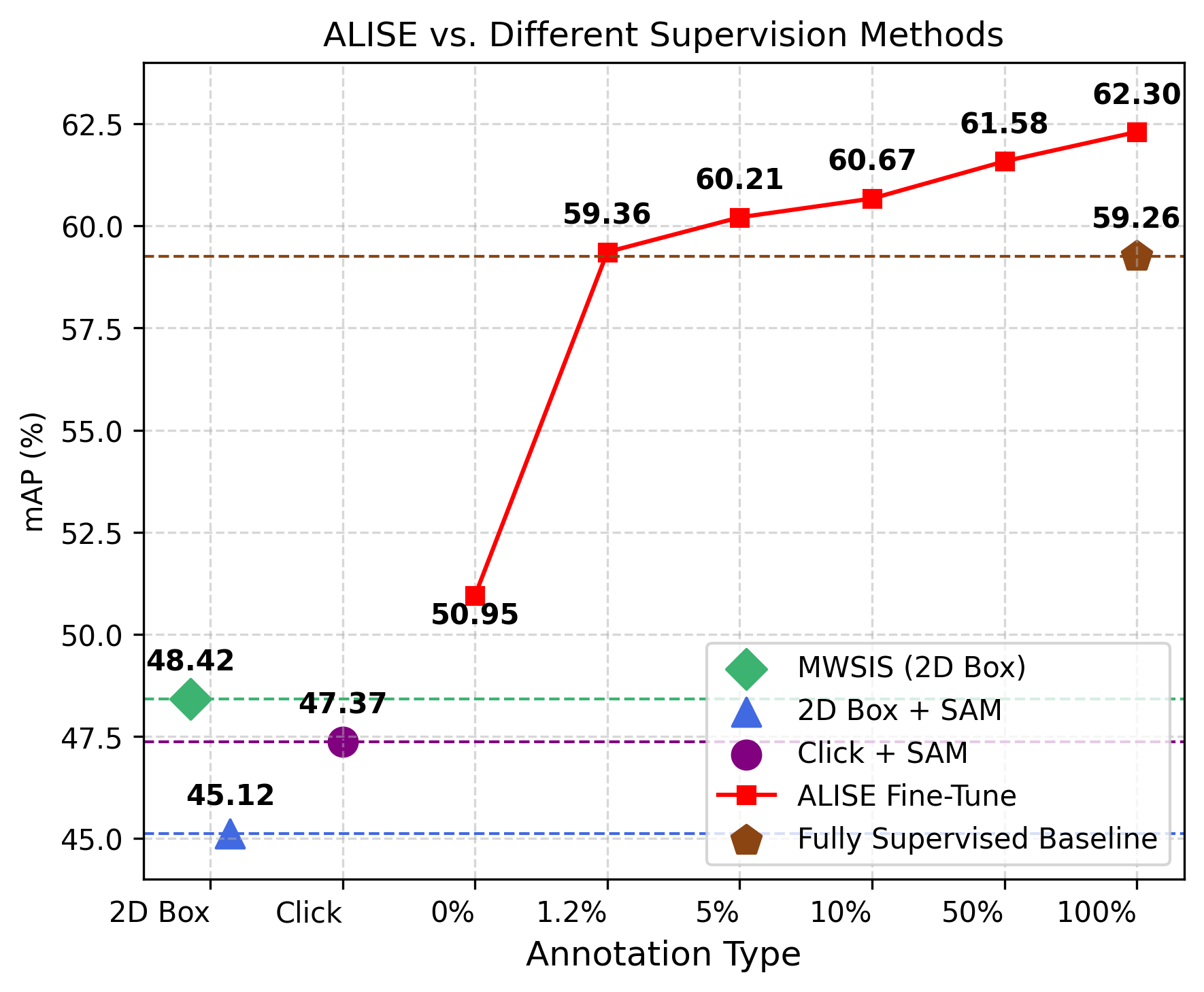
- 在公开数据集上达到50.95% mAP,超越有监督方法2.53%
- 适合追求零标注训练的自动驾驶感知系统开发者
户外激光雷达点云的实例分割人工标注成本极高。现有方法虽试图减轻标注负担,但仍依赖部分人工标记。为彻底消除此依赖,我们提出ALISE框架,实现完全无标注的激光雷达实例分割。核心挑战在于生成高质量伪标签。方法首先通过文本与图像引导的视觉基础模型生成初始伪标签,再经专用时空投票模块融合2D与3D语义,实现离线与在线优化。为提升特征学习能力,引入两类语义监督:基于2D先验的损失注入视觉知识至3D网络,以及新型原型对比损失,利用3D语义一致性构建判别性特征空间。该设计显著提升性能,建立无监督3D实例分割新基准。值得注意的是,其表现甚至优于使用真实2D边界框监督的MWSIS方法,mAP达50.95%(对比48.42%)。
原文摘要 · Abstract (English)
The manual annotation of outdoor LiDAR point clouds for instance segmentation is extremely costly and time-consuming. Current methods attempt to reduce this burden but still rely on some form of human labeling. To completely eliminate this dependency, we introduce ALISE, a novel framework that performs LiDAR instance segmentation without any annotations. The central challenge is to generate high-quality pseudo-labels in a fully unsupervised manner. Our approach starts by employing Vision Foundation Models (VFMs), guided by text and images, to produce initial pseudo-labels. We then refine these labels through a dedicated spatio-temporal voting module, which combines 2D and 3D semantics for both offline and online optimization. To achieve superior feature learning, we further introduce two forms of semantic supervision: a set of 2D prior-based losses that inject visual knowledge into the 3D network, and a novel prototype-based contrastive loss that builds a discriminative feature space by exploiting 3D semantic consistency. This comprehensive design results in significant performance gains, establishing a new state-of-the-art for unsupervised 3D instance segmentation. Remarkably, our approach even outperforms MWSIS, a method that operates with supervision from ground-truth (GT) 2D bounding boxes by a margin of 2.53% in mAP (50.95% vs. 48.42%).
Thank you to arXiv for use of its open access interoperability. PaperDance 不是 arXiv 官方产品;中文卡片由大模型生成,请以原文为准。