让大模型学会按需调用工具,提升复杂任务的推理能力。
Tool-Augmented Policy Optimization: Synergizing Reasoning and Adaptive Tool Use with Reinforcement Learning
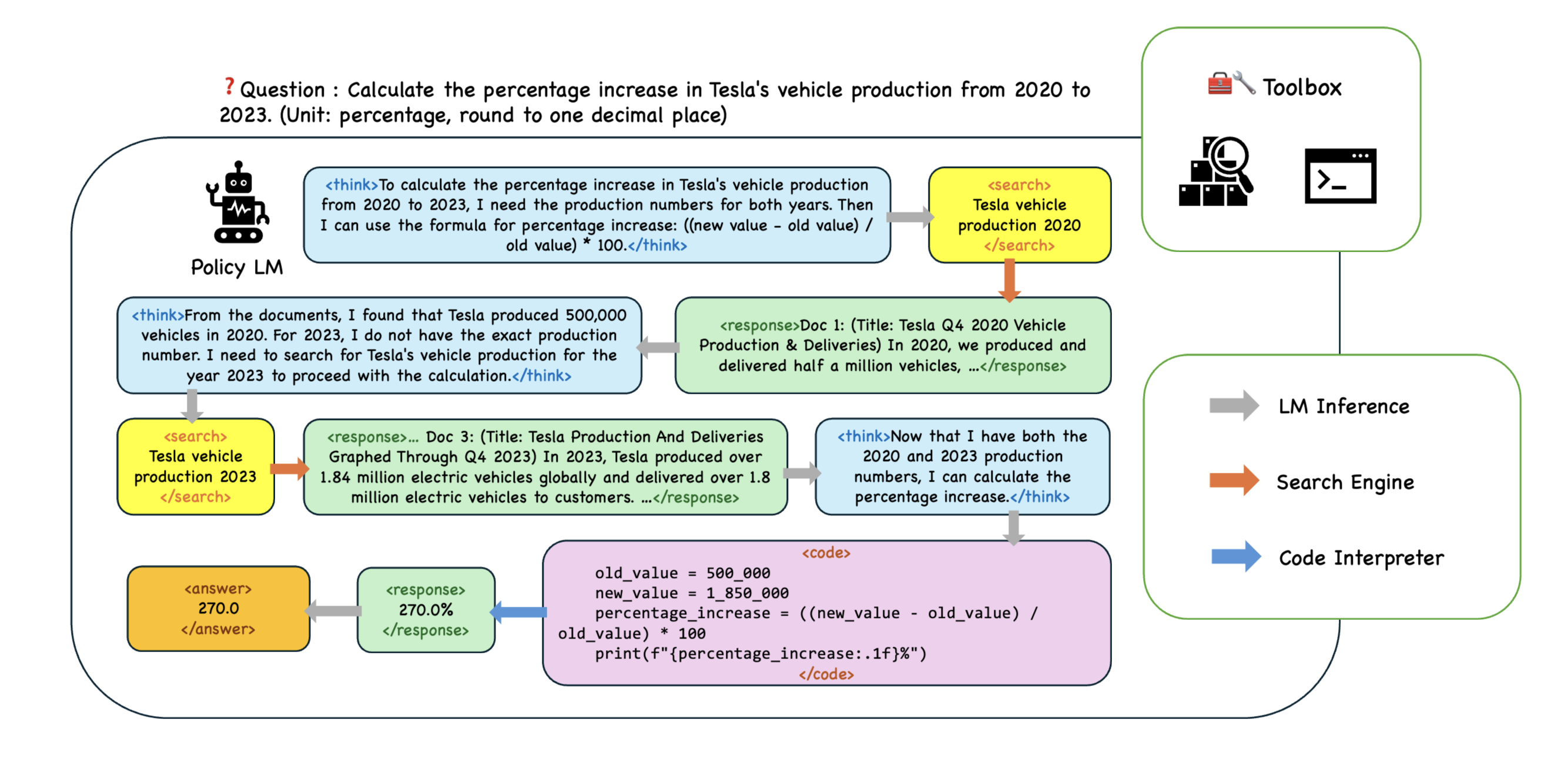
- 用强化学习让模型动态决定何时调用计算器、搜索等工具。
- 在数学和知识类任务上,性能超越同参数量模型。
- 避免过度调用工具,适合需要精准计算与实时信息的任务
大型语言模型在测试时扩展中通过生成额外推理标记显著提升了数学推理表现。然而,仅依赖直接推理的模型在需要最新知识或计算工具(如计算器、代码解释器)的复杂任务上仍显不足。为此,我们提出工具增强策略优化(TAPO),一种将多跳推理与自适应工具调用相结合的强化学习框架。该方法基于动态采样策略优化(DAPO)改进而来,使模型能动态穿插复杂推理与按需调用工具(包括搜索API和Python解释器)。为支持研究,我们构建了两个新数据集:TAPO-easy-60K 和 TAPO-hard-18K,专门用于训练和评估基于事实的推理与数学计算能力。在 Qwen2.5-3B 与 Qwen2.5-7B 模型上的实验表明,两者在需外部知识与数学计算的任务上均达到同类参数量模型中的最先进水平。值得注意的是,TAPO 实现了比基线更高效的工具使用,且有效防止因奖励漏洞导致的过度调用。结果表明,结合高级推理与工具使用可显著提升模型在知识密集型与计算密集型任务中的表现。
原文摘要 · Abstract (English)
Recent advances in large language models (LLMs) have popularized test-time scaling, where models generate additional reasoning tokens before producing final answers. These approaches have demonstrated significant performance improvements on benchmarks involving mathematical reasoning. However, language models relying solely on direct inference still struggle with tasks demanding up-to-date knowledge or computational tools such as calculators and code interpreters for complex arithmetic operations. To overcome these limitations, we propose Tool-Augmented Policy Optimization (TAPO), a novel reinforcement learning framework that systematically integrates multi-hop reasoning with adaptive tool-calling capabilities. Our approach employs a modified version of Dynamic Sampling Policy Optimization (DAPO), a recently developed RL paradigm, which we adapt specifically for tool invocation scenarios, enabling models to dynamically interleave complex reasoning with on-demand tool usage (including search APIs and Python interpreters). To support this research, we introduce two new datasets: TAPO-easy-60K and TAPO-hard-18K, specifically designed to train and evaluate both fact-based reasoning and mathematical calculation capabilities. Our experiments on Qwen2.5-3B and Qwen2.5-7B models demonstrate the effectiveness of our approach, with both models achieving state-of-the-art performance on tasks requiring external knowledge and mathematical computation among methods with comparable parameters. Notably, TAPO achieves more efficient tool utilization than baseline methods while preventing excessive calls caused by reward hacking. These results highlight the significant potential of combining advanced reasoning with tool usage to enhance model performance in knowledge-intensive and computationally demanding tasks.
Thank you to arXiv for use of its open access interoperability. PaperDance 不是 arXiv 官方产品;中文卡片由大模型生成,请以原文为准。