统一渲染多模态3D场景,实现高保真几何与视觉一致性。
UniGS: Unified Geometry-Aware Gaussian Splatting for Multimodal Rendering
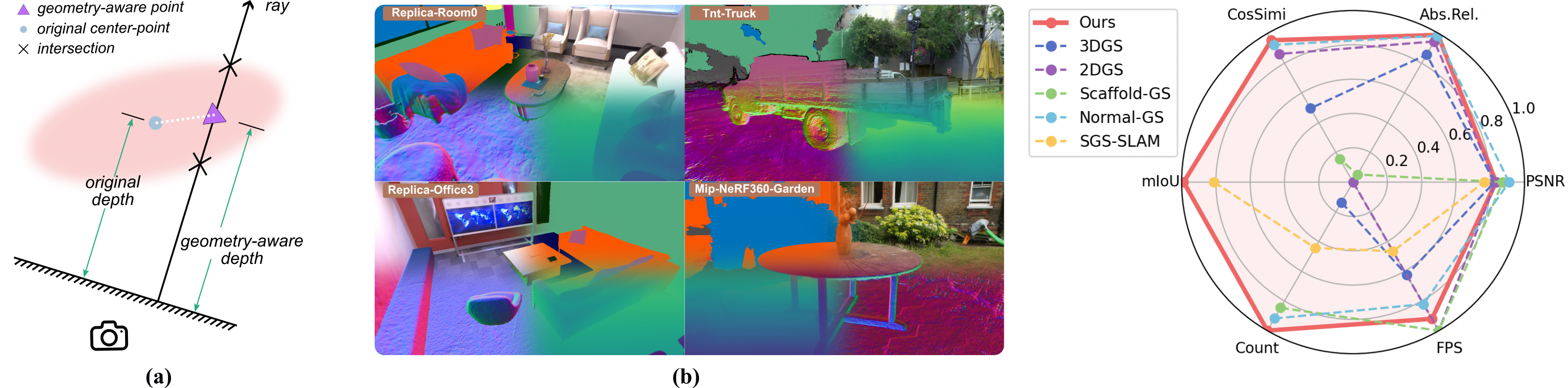
- 用可微分的射线-椭球相交计算深度,优化高斯分布的旋转与缩放。
- 同时输出真实感图像、精确深度图和一致法向量,精度领先现有方法。
- 支持训练中可学习剪枝,显著降低存储与计算开销,适合实时应用。
本文提出UniGS,一种基于3D高斯溅射的统一地图表示与可微分框架,用于高保真多模态3D重建。该框架集成CUDA加速的光栅化管线,可同步渲染照片级真实感RGB图像、几何精确的深度图、一致的表面法向量以及语义置信度。通过可微分射线-椭球相交替代高斯中心计算深度,实现对旋转与尺度属性的有效优化。同时推导出表面法向量渲染的解析梯度公式,保障三维重建场景的几何一致性。为提升计算与存储效率,引入可学习属性,实现训练中对贡献度低高斯的可微剪枝。定量与定性实验表明,该方法在所有模态下均达到当前最优重建精度,验证了其几何感知范式的优势。源代码与多模态可视化工具将开源于GitHub。
原文摘要 · Abstract (English)
In this paper, we propose UniGS, a unified map representation and differentiable framework for high-fidelity multimodal 3D reconstruction based on 3D Gaussian Splatting. Our framework integrates a CUDA-accelerated rasterization pipeline capable of rendering photo-realistic RGB images, geometrically accurate depth maps, consistent surface normals, and semantic logits simultaneously. We redesign the rasterization to render depth via differentiable ray-ellipsoid intersection rather than using Gaussian centers, enabling effective optimization of rotation and scale attribute through analytic depth gradients. Furthermore, we derive the analytic gradient formulation for surface normal rendering, ensuring geometric consistency among reconstructed 3D scenes. To improve computational and storage efficiency, we introduce a learnable attribute that enables differentiable pruning of Gaussians with minimal contribution during training. Quantitative and qualitative experiments demonstrate state-of-the-art reconstruction accuracy across all modalities, validating the efficacy of our geometry-aware paradigm. Source code and multimodal viewer will be available on GitHub.
Thank you to arXiv for use of its open access interoperability. PaperDance 不是 arXiv 官方产品;中文卡片由大模型生成,请以原文为准。