提出自适应控制框架LS-OGD,实现多模态学习在概念漂移下的稳定更新。
Lyapunov-Stable Adaptive Control for Multimodal Concept Drift
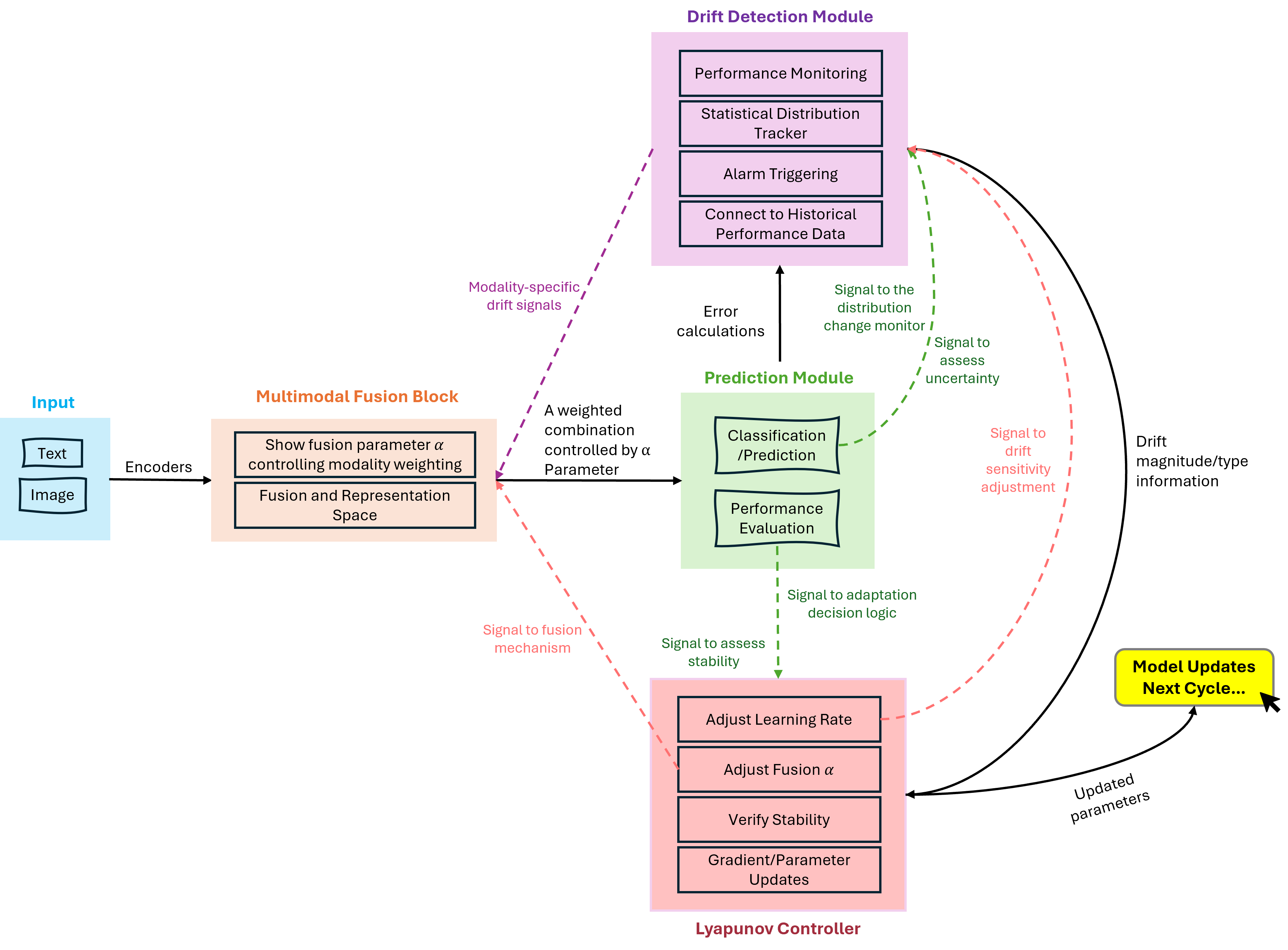
- 通过在线控制器动态调节学习率与模态融合权重
- 理论证明预测误差在漂移下有界,漂移停止后可归零
- 有效隔离严重模态漂移,提升系统鲁棒性
多模态学习系统在非平稳环境中常因概念漂移导致性能下降,尤其当各模态出现独立漂移且缺乏持续稳定适应机制时问题更显著。本文提出LS-OGD这一新型自适应控制框架,用于在概念漂移下实现鲁棒的多模态学习。该框架采用在线控制器,根据检测到的漂移和预测误差变化,动态调整模型学习率及不同模态间的融合权重。理论上证明:在有界漂移条件下,系统预测误差一致最终有界;若漂移终止,则误差收敛至零。此外,实证表明自适应融合策略能有效隔离并缓解严重模态特定漂移的影响,保障系统韧性与容错能力。这些理论保证为构建可靠、持续自适应的多模态学习系统提供了原则性基础。
原文摘要 · Abstract (English)
Multimodal learning systems often struggle in non-stationary environments due to concept drift, where changing data distributions can degrade performance. Modality-specific drifts and the lack of mechanisms for continuous, stable adaptation compound this challenge. This paper introduces LS-OGD, a novel adaptive control framework for robust multimodal learning in the presence of concept drift. LS-OGD uses an online controller that dynamically adjusts the model's learning rate and the fusion weights between different data modalities in response to detected drift and evolving prediction errors. We prove that under bounded drift conditions, the LS-OGD system's prediction error is uniformly ultimately bounded and converges to zero if the drift ceases. Additionally, we demonstrate that the adaptive fusion strategy effectively isolates and mitigates the impact of severe modality-specific drift, thereby ensuring system resilience and fault tolerance. These theoretical guarantees establish a principled foundation for developing reliable and continuously adapting multimodal learning systems.
Thank you to arXiv for use of its open access interoperability. PaperDance 不是 arXiv 官方产品;中文卡片由大模型生成,请以原文为准。