用脉冲神经网络实现低功耗实时脑机解码,性能优于传统方法。
A Scalable, Causal, and Energy Efficient Framework for Neural Decoding with Spiking Neural Networks
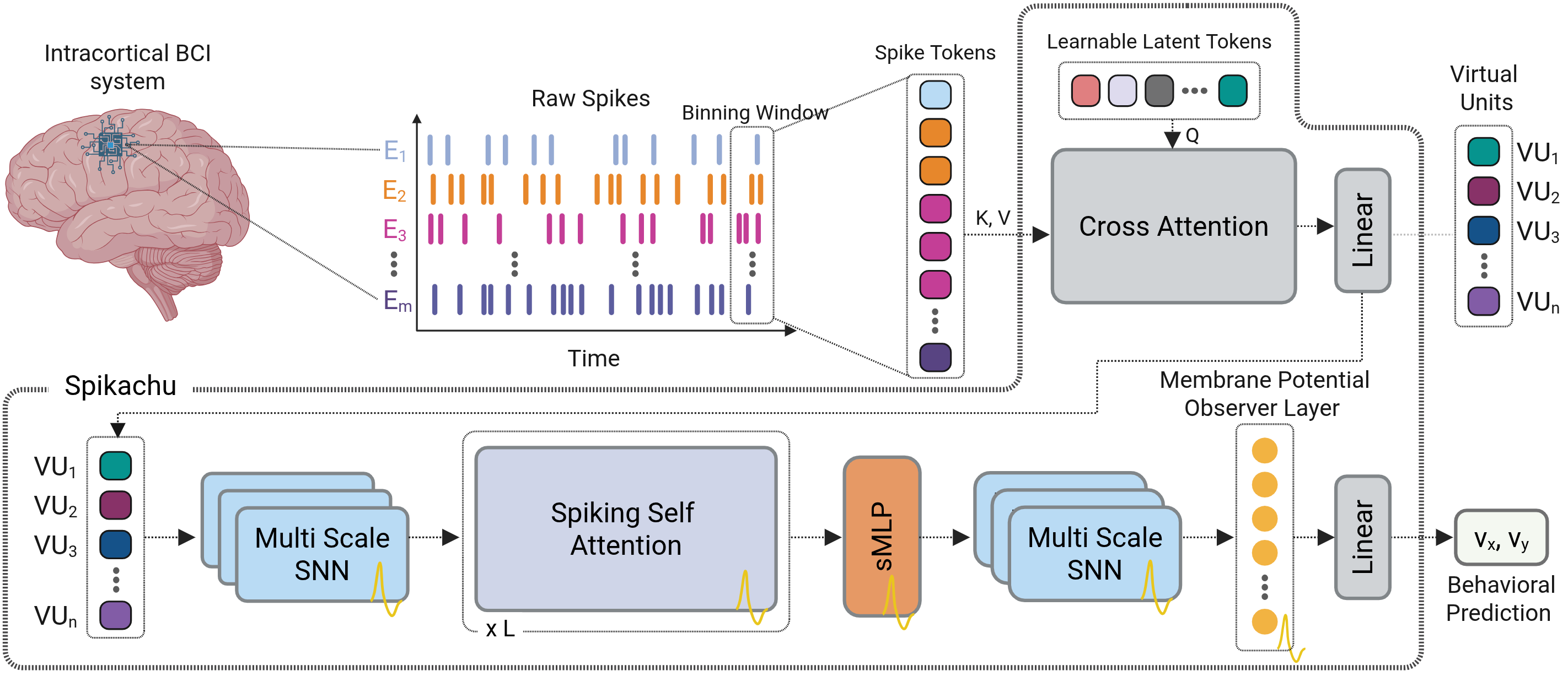
- 直接处理分箱脉冲,通过共享潜在空间提取时序特征
- 单会话训练能耗低至基线的1/418,113次实验验证有效
- 支持跨会话、跨受试者少样本迁移,适合嵌入式设备
脑-机接口(BCIs)有望为神经运动障碍患者提供言语和假肢控制等重要功能。其核心是神经解码器,将神经活动映射为意图行为。现有基于学习的解码方法分为两类:简单但泛化能力差的因果模型,或复杂但非因果、离线可扩展、实时性差的模型。两者均依赖高功耗的人工神经网络主干,难以集成到资源受限的现实系统中。脉冲神经网络(SNNs)提供了一种替代方案:它们具有因果特性,适合实时应用,且能耗极低。为此,我们提出Spikachu——一种基于SNN的可扩展、因果且节能的神经解码框架。该方法直接处理分箱脉冲,将其投影到共享潜在空间,由适应输入时序的脉冲模块提取特征,并对潜在表示进行整合与解码以生成行为预测。我们在6只非人灵长类动物的113个记录会话上评估,总计43小时数据。结果表明,使用单会话训练时,该方法在2.26至418.81倍更低能耗下优于因果基线;通过多会话、多受试者训练,性能进一步提升,实现了对未见会话、受试者和任务的少样本迁移。总体而言,Spikachu提供了一种高性能、低功耗、在线兼容的神经解码框架,性能媲美顶尖模型,能耗却低数个数量级。
原文摘要 · Abstract (English)
Brain-computer interfaces (BCIs) promise to enable vital functions, such as speech and prosthetic control, for individuals with neuromotor impairments. Central to their success are neural decoders, models that map neural activity to intended behavior. Current learning-based decoding approaches fall into two classes: simple, causal models that lack generalization, or complex, non-causal models that generalize and scale offline but struggle in real-time settings. Both face a common challenge, their reliance on power-hungry artificial neural network backbones, which makes integration into real-world, resource-limited systems difficult. Spiking neural networks (SNNs) offer a promising alternative. Because they operate causally these models are suitable for real-time use, and their low energy demands make them ideal for battery-constrained environments. To this end, we introduce Spikachu: a scalable, causal, and energy-efficient neural decoding framework based on SNNs. Our approach processes binned spikes directly by projecting them into a shared latent space, where spiking modules, adapted to the timing of the input, extract relevant features; these latent representations are then integrated and decoded to generate behavioral predictions. We evaluate our approach on 113 recording sessions from 6 non-human primates, totaling 43 hours of recordings. Our method outperforms causal baselines when trained on single sessions using between 2.26 and 418.81 times less energy. Furthermore, we demonstrate that scaling up training to multiple sessions and subjects improves performance and enables few-shot transfer to unseen sessions, subjects, and tasks. Overall, Spikachu introduces a scalable, online-compatible neural decoding framework based on SNNs, whose performance is competitive relative to state-of-the-art models while consuming orders of magnitude less energy.
Thank you to arXiv for use of its open access interoperability. PaperDance 不是 arXiv 官方产品;中文卡片由大模型生成,请以原文为准。