用扩散模型+退火Langevin动态,实现高效后验采样
Posterior Sampling by Combining Diffusion Models with Annealed Langevin Dynamics
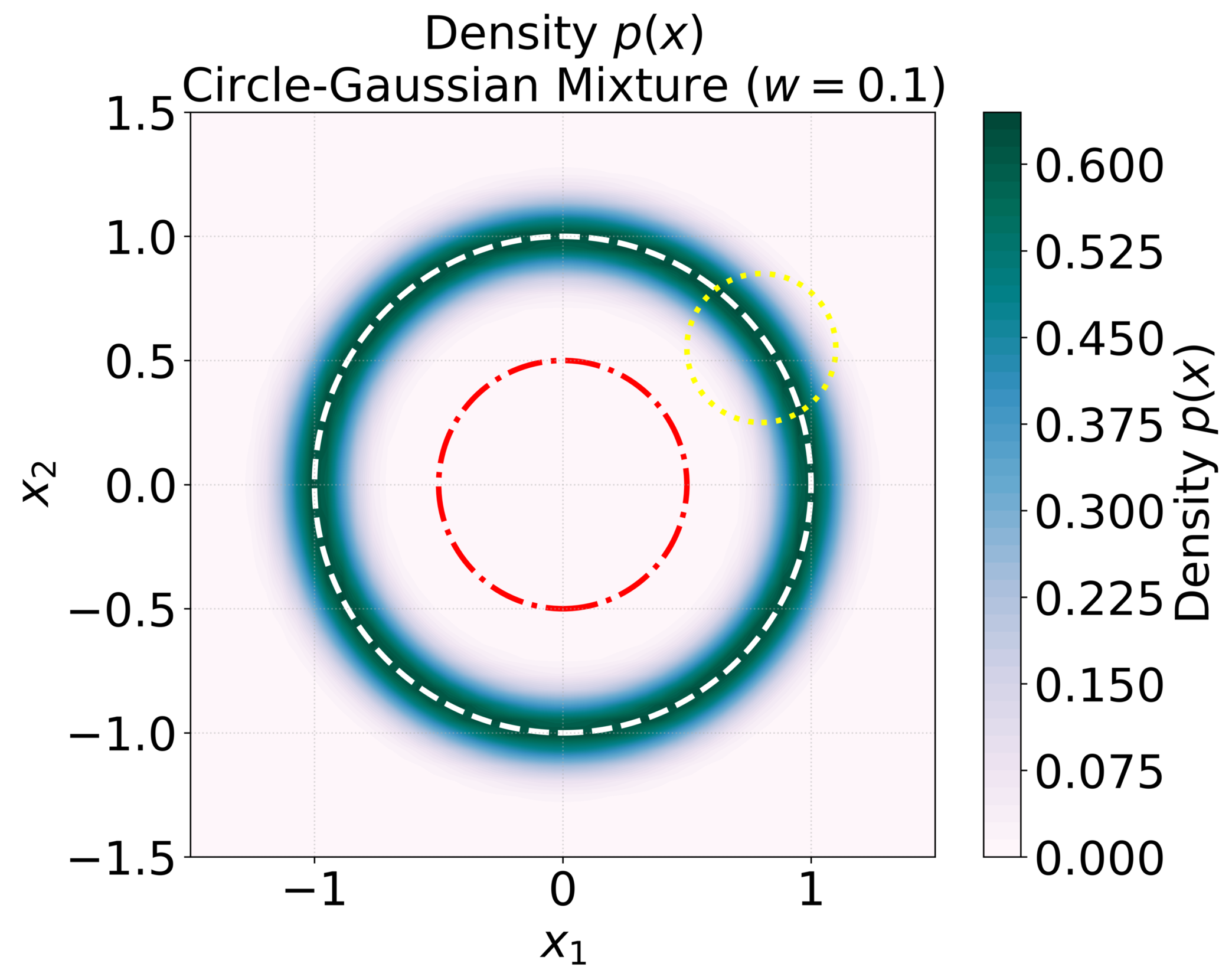
- 结合扩散模型与退火Langevin动态进行条件采样
- 仅需分数误差的L⁴界即可在多项式时间内完成采样
- 适用于图像修复、去模糊等需要精确后验的任务
给定一个噪声线性观测 $y = Ax + ξ$ 和分布 $p(x)$ 的良好近似先验时,如何从后验 $p(x mid y)$ 中采样?后验采样为补全、去模糊和MRI重建等任务提供了准确且公平的框架。然而,一般情况下近似后验采样在计算上是不可行的。为克服这一困难,本文聚焦于(局部或全局)对数凹分布 $p(x)$。在此情形下,当获得 $p(x)$ 的精确得分时,Langevin动力学可生成后验样本,但对得分估计误差敏感,需满足矩生成函数(MGF)界(即次指数误差)。相比之下,在无条件设定中,扩散模型仅需得分误差的 $L^2$ 界即可成功。本文证明:将扩散模型与一种退火版Langevin动态相结合,可在多项式时间内实现条件采样,且仅需得分误差的 $L^4$ 界。
原文摘要 · Abstract (English)
Given a noisy linear measurement $y = Ax + ξ$ of a distribution $p(x)$, and a good approximation to the prior $p(x)$, when can we sample from the posterior $p(x \mid y)$? Posterior sampling provides an accurate and fair framework for tasks such as inpainting, deblurring, and MRI reconstruction, and several heuristics attempt to approximate it. Unfortunately, approximate posterior sampling is computationally intractable in general. To sidestep this hardness, we focus on (local or global) log-concave distributions $p(x)$. In this regime, Langevin dynamics yields posterior samples when the exact scores of $p(x)$ are available, but it is brittle to score--estimation error, requiring an MGF bound (sub-exponential error). By contrast, in the unconditional setting, diffusion models succeed with only an $L^2$ bound on the score error. We prove that combining diffusion models with an annealed variant of Langevin dynamics achieves conditional sampling in polynomial time using merely an $L^4$ bound on the score error.
Thank you to arXiv for use of its open access interoperability. PaperDance 不是 arXiv 官方产品;中文卡片由大模型生成,请以原文为准。