从点云自身学习几何先验,重建更精细的三维表面。
Self-Supervised Implicit Attention Priors for Point Cloud Reconstruction
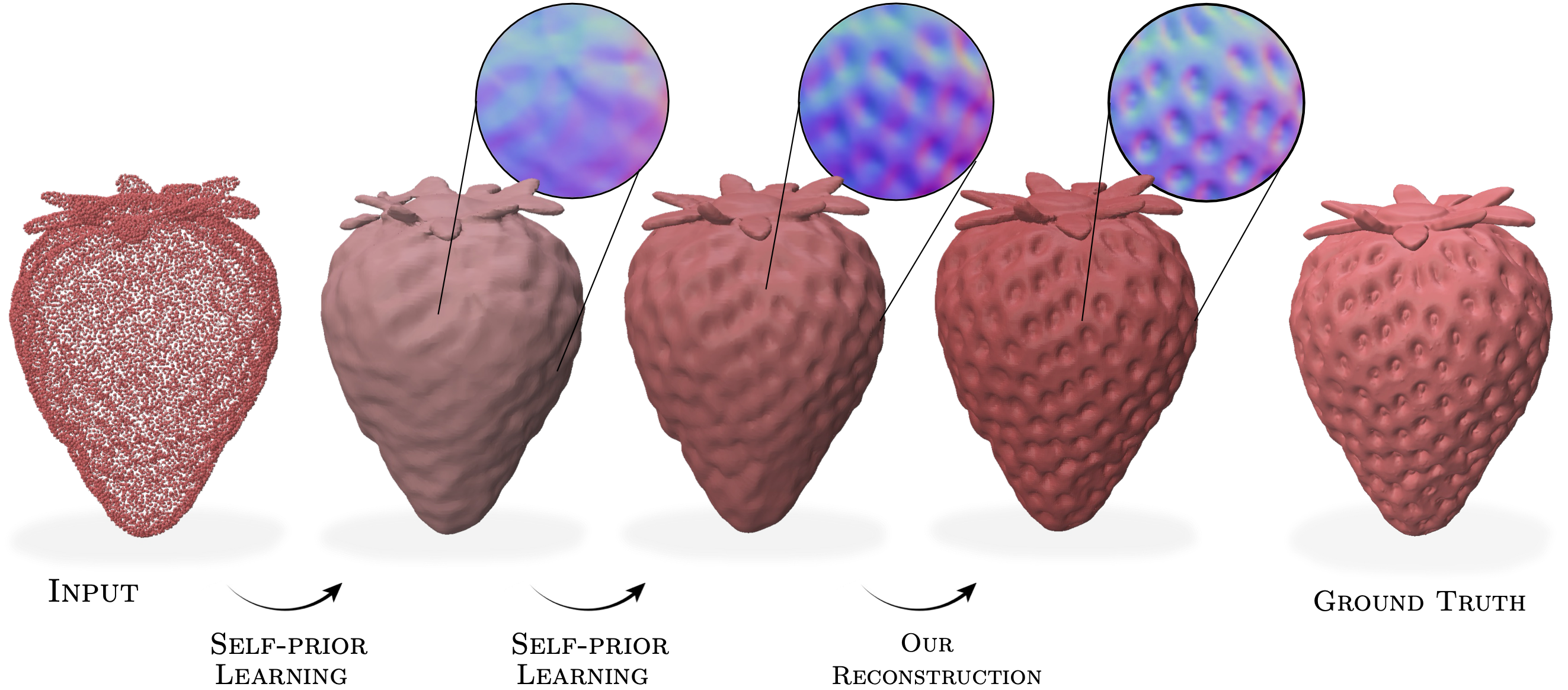
- 用交叉注意力机制让网络自学习点云中的重复结构和远距离关联
- 无需外部数据,在自监督下重建出细节丰富、抗退化的高质量表面
- 适合需要高保真重建且数据不完整或有噪声的场景
从不规则点云恢复高质量曲面是病态问题,除非有强几何先验。本文提出一种隐式自先验方法,直接从输入点云中提炼形状特异性先验,并嵌入隐式神经表示中。通过联合训练一个可学习嵌入的小字典与隐式距离场,查询时场通过交叉注意力关联字典,从而捕捉并复用形状中的重复结构与长程相关性。仅使用自监督点云重建损失优化,无需外部训练数据。训练后的场通过自动微分提取密集点和解析法向,融合进鲁棒隐式移动最小二乘(RIMLS)框架。实验表明,该混合策略在保留输入细粒度几何特征的同时,利用学习先验正则化稀疏区域,优于经典与基于学习的方法,在细节保持与对常见数据退化的鲁棒性上表现更优。
原文摘要 · Abstract (English)
Recovering high-quality surfaces from irregular point cloud is ill-posed unless strong geometric priors are available. We introduce an implicit self-prior approach that distills a shape-specific prior directly from the input point cloud itself and embeds it within an implicit neural representation. This is achieved by jointly training a small dictionary of learnable embeddings with an implicit distance field; at every query location, the field attends to the dictionary via cross-attention, enabling the network to capture and reuse repeating structures and long-range correlations inherent to the shape. Optimized solely with self-supervised point cloud reconstruction losses, our approach requires no external training data. To effectively integrate this learned prior while preserving input fidelity, the trained field is then sampled to extract densely distributed points and analytic normals via automatic differentiation. We integrate the resulting dense point cloud and corresponding normals into a robust implicit moving least squares (RIMLS) formulation. We show this hybrid strategy preserves fine geometric details in the input data, while leveraging the learned prior to regularize sparse regions. Experiments show that our method outperforms both classical and learning-based approaches in generating high-fidelity surfaces with superior detail preservation and robustness to common data degradations.
Thank you to arXiv for use of its open access interoperability. PaperDance 不是 arXiv 官方产品;中文卡片由大模型生成,请以原文为准。