让GPU直接控制通信,提升MoE模型的训练效率
GPU-Initiated Networking for NCCL
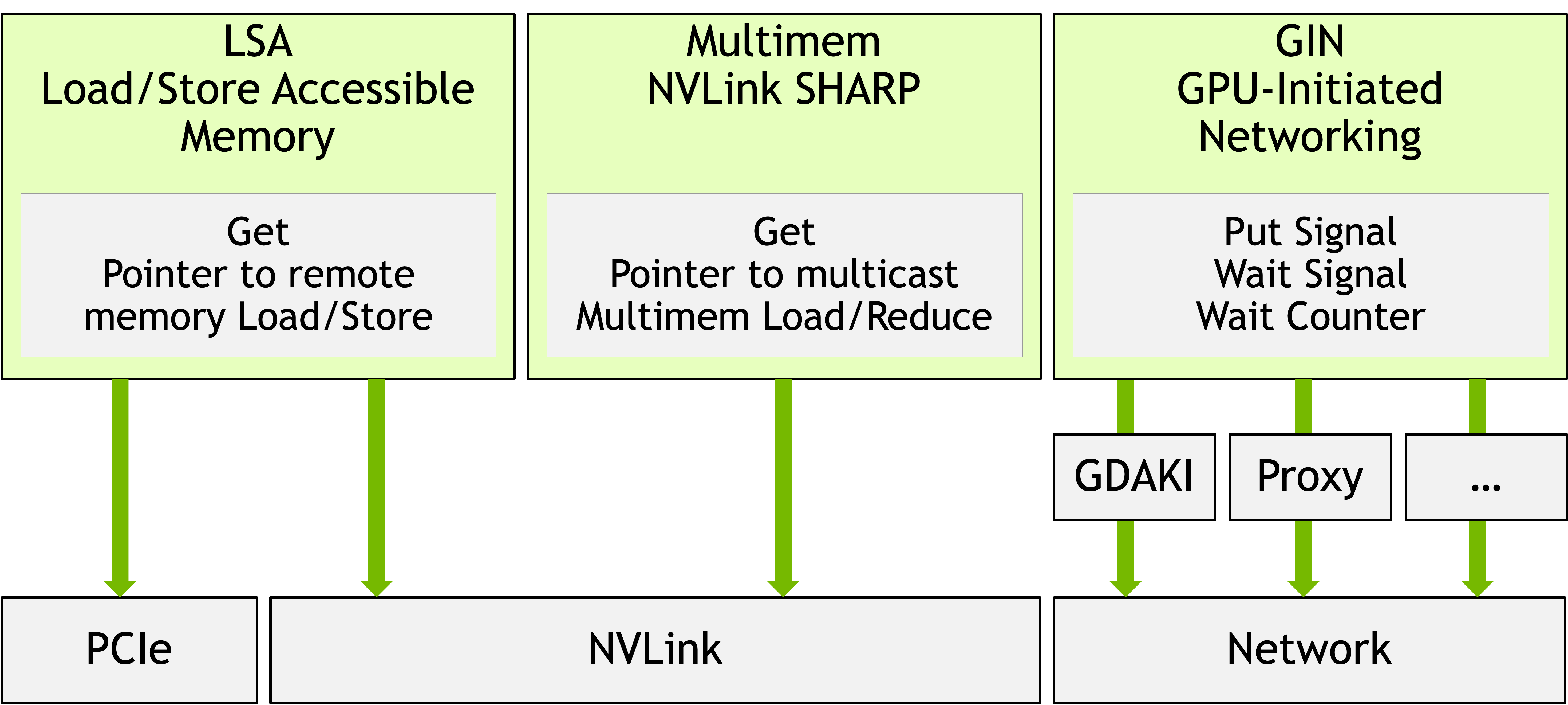
- GPU直接发起网络通信,跳过CPU协调
- 在MoE场景下延迟降低37%,吞吐提升2.1倍
- 支持多种硬件,适合大规模AI训练场景
现代AI工作负载,尤其是混合专家(MoE)架构,对低延迟、细粒度的GPU间通信需求日益增长,且要求设备端控制。传统GPU通信采用主机主导模式,由CPU协调所有操作,虽适用于集体运算,但难以满足计算与通信紧密耦合的应用。NCCL 2.28引入设备端API,包含三种模式:用于NVLink/PCIe的LSA、用于NVLink SHARP的Multimem,以及用于网络RDMA的GPU-Initiated Networking(GIN)。本文提出GIN架构,其采用三层设计:一是主机侧的NCCL Core API用于设备通信器设置和集体内存窗口注册;二是设备侧API,可在CUDA核函数中调用远程内存操作;三是双语义网络插件架构,支持GPUDirect异步内核发起和代理模式,实现广泛硬件兼容。前者利用DOCA GPUNetIO实现GPU到网卡的直连通信,后者通过无锁队列在标准RDMA网络上实现等效功能。通过与DeepEP(MoE通信库)集成验证了GIN的实用性。全面基准测试表明,GIN在保持NCCL统一运行时的基础上,实现了设备端发起通信,兼具低延迟与集体算法优势。
原文摘要 · Abstract (English)
Modern AI workloads, especially Mixture-of-Experts (MoE) architectures, increasingly demand low-latency, fine-grained GPU-to-GPU communication with device-side control. Traditional GPU communication follows a host-initiated model, where the CPU orchestrates all communication operations - a characteristic of the CUDA runtime. Although robust for collective operations, applications requiring tight integration of computation and communication can benefit from device-initiated communication that eliminates CPU coordination overhead. NCCL 2.28 introduces the Device API with three operation modes: Load/Store Accessible (LSA) for NVLink/PCIe, Multimem for NVLink SHARP, and GPU-Initiated Networking (GIN) for network RDMA. This paper presents the GIN architecture, design, semantics, and highlights its impact on MoE communication. GIN builds on a three-layer architecture: i) NCCL Core host-side APIs for device communicator setup and collective memory window registration; ii) Device-side APIs for remote memory operations callable from CUDA kernels; and iii) A network plugin architecture with dual semantics (GPUDirect Async Kernel-Initiated and Proxy) for broad hardware support. The GPUDirect Async Kernel-Initiated backend leverages DOCA GPUNetIO for direct GPU-to-NIC communication, while the Proxy backend provides equivalent functionality via lock-free GPU-to-CPU queues over standard RDMA networks. We demonstrate GIN's practicality through integration with DeepEP, an MoE communication library. Comprehensive benchmarking shows that GIN provides device-initiated communication within NCCL's unified runtime, combining low-latency operations with NCCL's collective algorithms and production infrastructure.
Thank you to arXiv for use of its open access interoperability. PaperDance 不是 arXiv 官方产品;中文卡片由大模型生成,请以原文为准。