针对眼底病数据不平衡问题,提出平衡少样本学习框架提升诊断准确性。
Balanced Few-Shot Episodic Learning for Accurate Retinal Disease Diagnosis
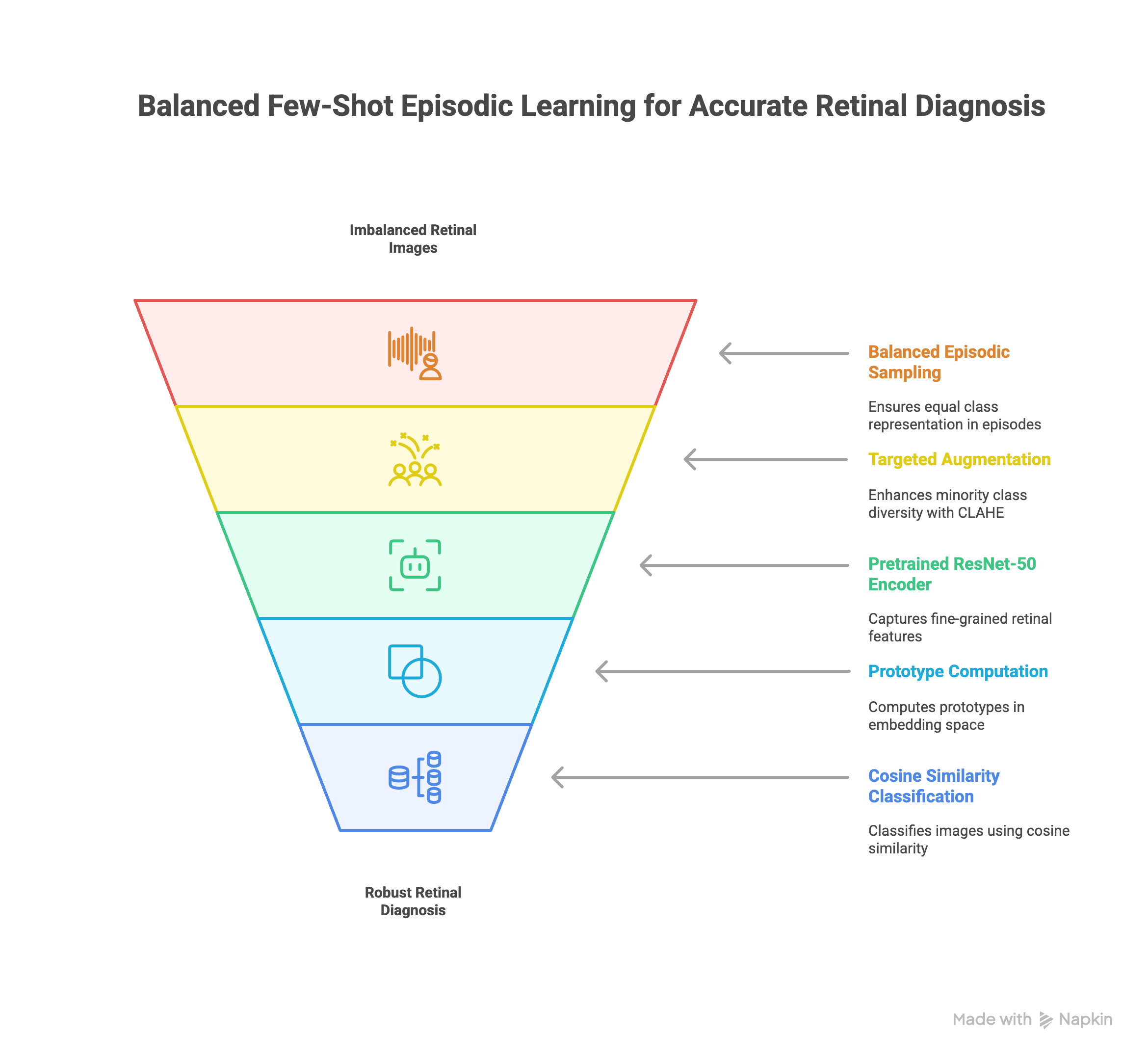
- 采用均衡采样确保每轮训练中各类疾病参与度一致
- 通过CLAHE增强少数类图像多样性,准确率显著提升
- 适合医疗影像少样本场景,对罕见病诊断更公平
自动化眼底疾病诊断在糖尿病视网膜病变和黄斑变性等疾病高发背景下至关重要。传统深度学习需大量标注数据,且类别间常存在严重不平衡,影响实际可靠性。少样本学习(FSL)通过仅用少量样本即可实现泛化,本研究提出一种面向Retinal Fundus Multi-Disease Image Dataset(RFMiD)的平衡少样本情景学习框架。聚焦十类主要疾病,虽仍存在明显类别不平衡(如糖尿病视网膜病变、黄斑孔等为多数类,视盘水肿、分支静脉阻塞等为少数类),方法包含三部分:(i) 均衡情景采样,在每轮5路5样本任务中确保所有类别平等参与;(ii) 针对性增强,包括对比度受限自适应直方图均衡化(CLAHE)及色彩/几何变换,提升少数类多样性;(iii) 使用ImageNet预训练的ResNet-50编码器,因其擅长捕捉细微眼底特征。在嵌入空间计算原型,以余弦相似度分类,增强稳定性。模型在100个训练情景上训练,1000个测试情景上评估,显著提升整体准确率并降低对多数类的偏倚,尤其改善了低频疾病的诊断表现。结果表明,结合数据感知的少样本流程、均衡采样与CLAHE增强预处理,可在数据受限条件下实现更鲁棒、临床更公平的眼底病诊断。
原文摘要 · Abstract (English)
Automated retinal disease diagnosis is vital given the rising prevalence of conditions such as diabetic retinopathy and macular degeneration. Conventional deep learning approaches require large annotated datasets, which are costly and often imbalanced across disease categories, limiting their reliability in practice. Few-shot learning (FSL) addresses this challenge by enabling models to generalize from only a few labeled samples per class. In this study,we propose a balanced few-shot episodic learning framework tailored to the Retinal Fundus Multi-Disease Image Dataset (RFMiD). Focusing on the ten most represented classes, which still show substantial imbalance between majority diseases (e.g., Diabetic Retinopathy, Macular Hole) and minority ones (e.g., Optic Disc Edema, Branch Retinal Vein Occlusion), our method integrates three key components: (i) balanced episodic sampling, ensuring equal participation of all classes in each 5-way 5-shot episode; (ii) targeted augmentation, including Contrast Limited Adaptive Histogram Equalization (CLAHE) and color/geometry transformations, to improve minority-class diversity; and (iii) a ResNet-50 encoder pretrained on ImageNet, selected for its superior ability to capture fine-grained retinal features. Prototypes are computed in the embedding space and classification is performed with cosine similarity for improved stability. Trained on 100 episodes and evaluated on 1,000 test episodes, our framework achieves substantial accuracy gains and reduces bias toward majority classes, with notable improvements for underrepresented diseases. These results demonstrate that dataset-aware few-shot pipelines, combined with balanced sampling and CLAHE-enhanced preprocessing, can deliver more robust and clinically fair retinal disease diagnosis under data-constrained conditions.
Thank you to arXiv for use of its open access interoperability. PaperDance 不是 arXiv 官方产品;中文卡片由大模型生成,请以原文为准。