室温运行的事件触发红外传感器,速度超传统器件4倍
Uncooled Poisson Bolometer for High-Speed Event-Based Long-wave Thermal Imaging
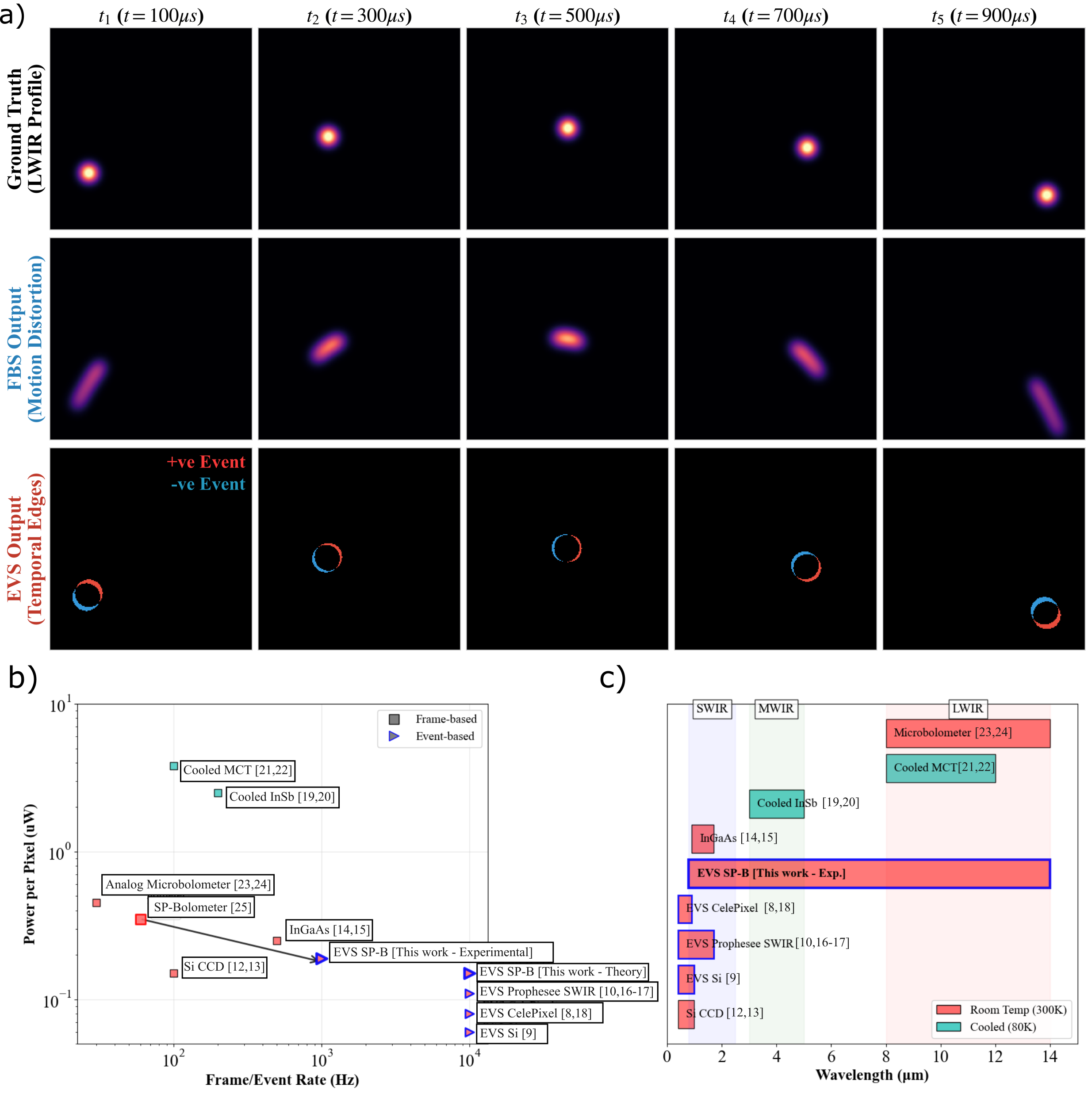
- 用自旋电子学实现泊松计数式探测,通过随机开关变化感知红外
- 室温下达1250赫兹事件率,功耗仅每像素0.2微瓦
- 适合高速热成像、低功耗场景,如自动驾驶与无人机
事件驱动视觉在自主导航和运动追踪等应用中提供高速、低功耗传感。然而,在长波红外领域实现该技术仍面临重大挑战。传统红外传感器受限于缓慢的热响应或低温冷却带来的高功耗。本文首次提出基于泊松计数模式的事件驱动红外探测器,采用自旋电子学泊松测热计,可实现0.8–14μm的宽带探测。在此模式下,红外信号通过统计可分辨的随机开关事件变化进行检测,实现室温工作并具备高时间分辨率。设备最大事件率达1250 Hz,较传统非制冷微测辐射热计提升4倍;单像素功耗仅为0.2 μW。本研究确立了红外传感的新原理,并为高速、低功耗事件驱动热成像提供了可行路径。
原文摘要 · Abstract (English)
Event-based vision provides high-speed, energy-efficient sensing for applications such as autonomous navigation and motion tracking. However, implementing this technology in the long-wave infrared remains a significant challenge. Traditional infrared sensors are hindered by slow thermal response times or the heavy power requirements of cryogenic cooling. Here, we introduce the first event-based infrared detector operating in a Poisson-counting regime. This is realized with a spintronic Poisson bolometer capable of broadband detection from 0.8-14$μ\text{m}$. In this regime, infrared signals are detected through statistically resolvable changes in stochastic switching events. This approach enables room-temperature operation with high timing resolution. Our device achieves a maximum event rate of 1,250 Hz, surpassing the temporal resolution of conventional uncooled microbolometers by a factor of 4. Power consumption is kept low at 0.2$μ$W per pixel. This work establishes an operating principle for infrared sensing and demonstrates a pathway toward high-speed, energy-efficient, event-driven thermal imaging.
Thank you to arXiv for use of its open access interoperability. PaperDance 不是 arXiv 官方产品;中文卡片由大模型生成,请以原文为准。