提出仿脑多智能体记忆框架,解决长对话中记忆丢失与行为不一致问题。
BMAM: Brain-inspired Multi-Agent Memory Framework
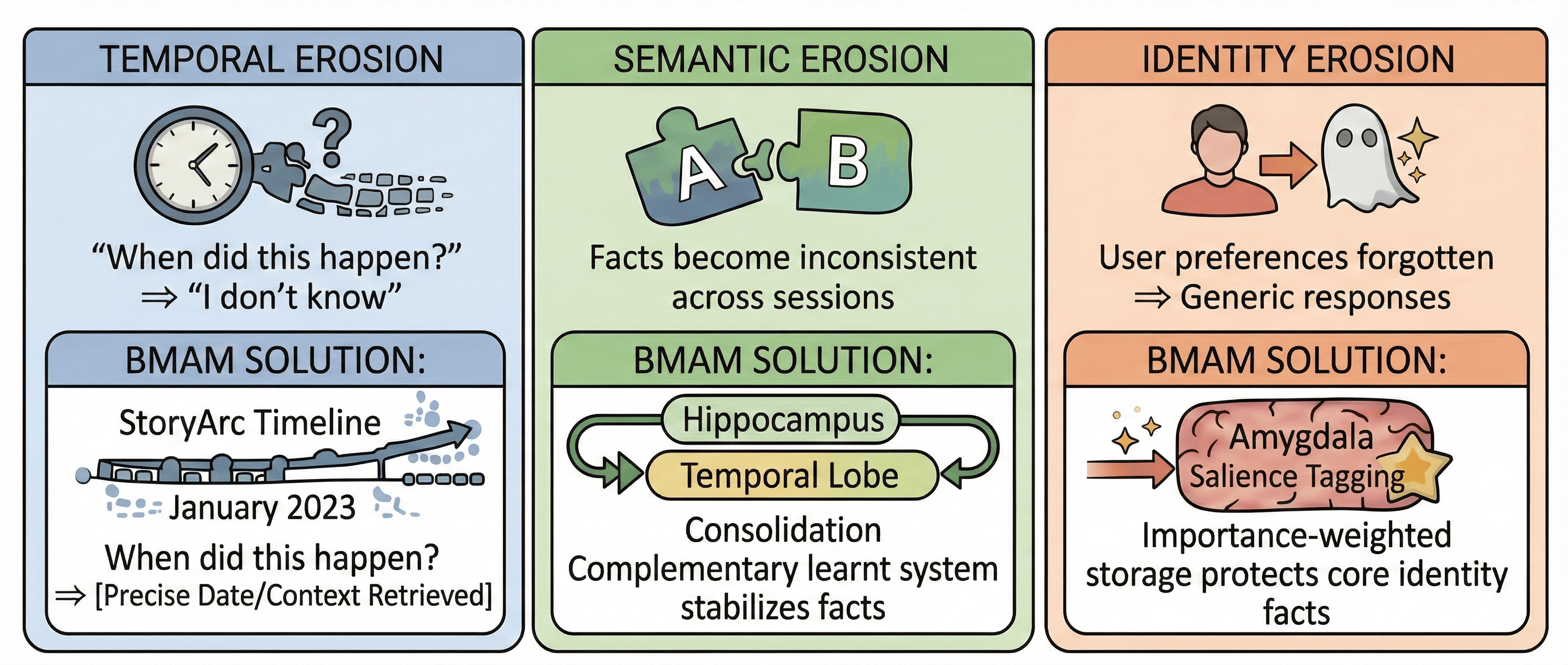
- 将记忆拆分为情景、语义、注意力和控制四类子系统,分时序协同工作
- 在LoCoMo基准上达78.45%准确率,证明情景记忆对时间推理关键作用
- 适合需要长期记忆与行为一致性的对话、任务代理等场景
基于语言模型的智能体在长时间交互中常面临时间相关信息丢失和跨会话行为不一致的问题,我们称之为“灵魂消解”。本文提出BMAM(仿脑多智能体记忆框架),一种通用记忆架构,将智能体记忆建模为一组功能分工明确的子系统,而非单一无结构存储。受认知记忆系统的启发,BMAM将记忆分解为情景、语义、显著性感知和控制导向四类组件,各组件在不同时间尺度上运作。为支持长时推理,BMAM沿显式时间线组织情景记忆,并通过融合多重互补信号实现证据检索。在LoCoMo基准上的实验表明,BMAM在标准长时评估设置下达到78.45%的准确率;消融分析证实,受海马体启发的情景记忆子系统在时间推理中起决定性作用。
原文摘要 · Abstract (English)
Language-model-based agents operating over extended interaction horizons face persistent challenges in preserving temporally grounded information and maintaining behavioral consistency across sessions, a failure mode we term soul erosion. We present BMAM (Brain-inspired Multi-Agent Memory), a general-purpose memory architecture that models agent memory as a set of functionally specialized subsystems rather than a single unstructured store. Inspired by cognitive memory systems, BMAM decomposes memory into episodic, semantic, salience-aware, and control-oriented components that operate at complementary time scales. To support long-horizon reasoning, BMAM organizes episodic memories along explicit timelines and retrieves evidence by fusing multiple complementary signals. Experiments on the LoCoMo benchmark show that BMAM achieves 78.45 percent accuracy under the standard long-horizon evaluation setting, and ablation analyses confirm that the hippocampus-inspired episodic memory subsystem plays a critical role in temporal reasoning.
Thank you to arXiv for use of its open access interoperability. PaperDance 不是 arXiv 官方产品;中文卡片由大模型生成,请以原文为准。