用全局信号指导局部学习,让神经网络更高效地训练。
Hebbian Learning with Global Direction
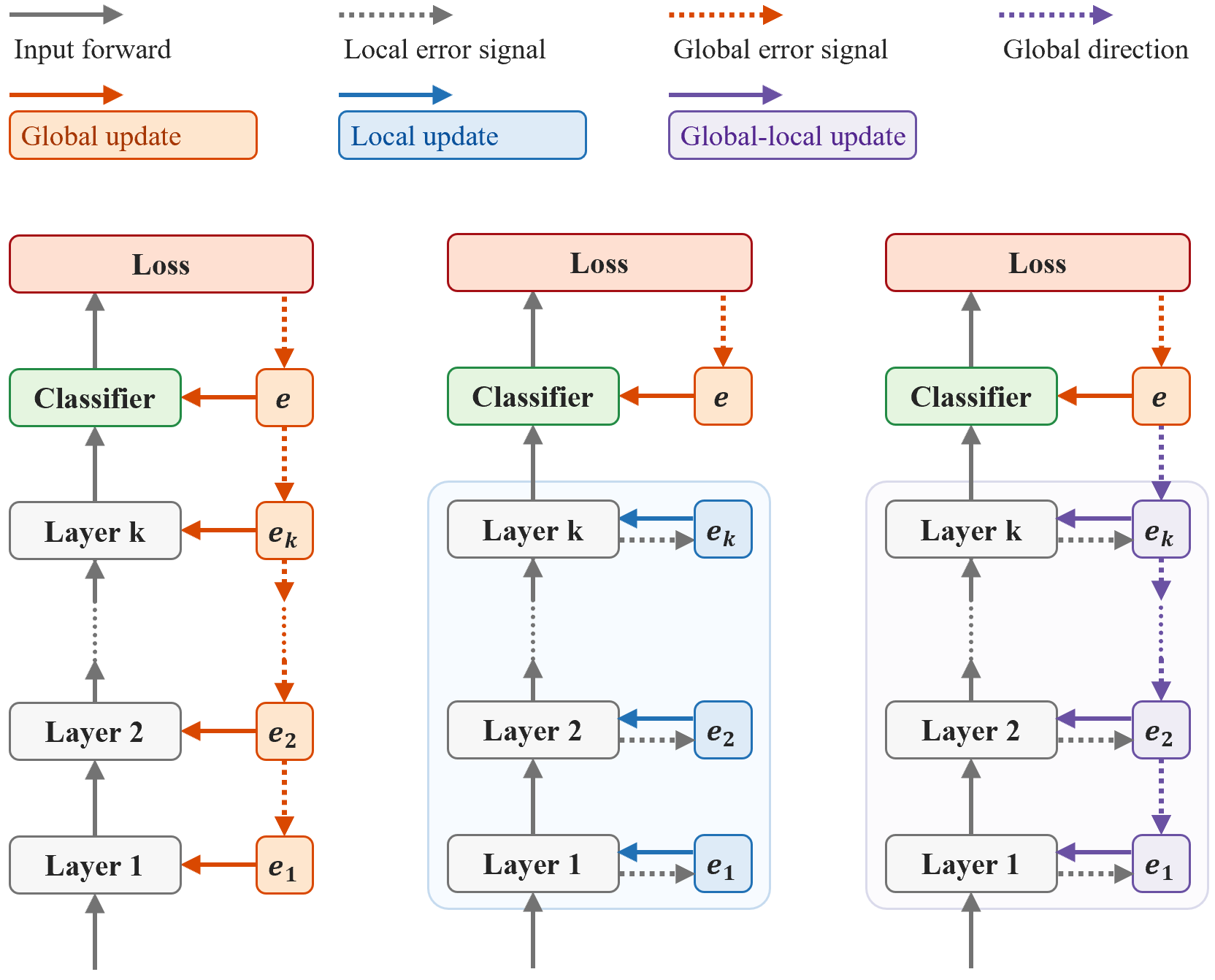
- 局部用Oja规则+竞争学习,全局用符号信号引导更新方向
- 在ImageNet上表现接近反向传播,显著缩小与标准方法的差距
- 模型无关设计,适用于多种网络和任务
反向传播算法推动了深度神经网络的巨大成功,但其缺乏生物学合理性且计算成本高,促使人们寻找替代训练方法。赫布学习因其生物合理性受到广泛关注,但其仅依赖局部信息、忽视全局任务目标的根本局限使其难以扩展。受神经调质与局部可塑性协同作用的启发,我们提出一种新型的、模型无关的全局引导赫布学习(GHL)框架,无缝融合局部与全局信息,实现跨多种网络与任务的可扩展性。具体而言,局部组件采用带竞争学习的Oja规则,确保稳定有效的局部更新;全局组件引入基于符号的信号,引导局部赫布可塑性的更新方向。大量实验表明,该方法持续优于现有赫布学习方法。值得注意的是,在ImageNet等大规模网络和复杂数据集上,本框架取得了具有竞争力的结果,并显著缩小了与标准反向传播的差距。
原文摘要 · Abstract (English)
Backpropagation algorithm has driven the remarkable success of deep neural networks, but its lack of biological plausibility and high computational costs have motivated the ongoing search for alternative training methods. Hebbian learning has attracted considerable interest as a biologically plausible alternative to backpropagation. Nevertheless, its exclusive reliance on local information, without consideration of global task objectives, fundamentally limits its scalability. Inspired by the biological synergy between neuromodulators and local plasticity, we introduce a novel model-agnostic Global-guided Hebbian Learning (GHL) framework, which seamlessly integrates local and global information to scale up across diverse networks and tasks. In specific, the local component employs Oja's rule with competitive learning to ensure stable and effective local updates. Meanwhile, the global component introduces a sign-based signal that guides the direction of local Hebbian plasticity updates. Extensive experiments demonstrate that our method consistently outperforms existing Hebbian approaches. Notably, on large-scale network and complex datasets like ImageNet, our framework achieves the competitive results and significantly narrows the gap with standard backpropagation.
Thank you to arXiv for use of its open access interoperability. PaperDance 不是 arXiv 官方产品;中文卡片由大模型生成,请以原文为准。