从调用树中学习推荐多智能体子图,提升协作可靠性
Learning to Recommend Multi-Agent Subgraphs from Calling Trees
- 基于调用树构建约束推荐框架,结合上下文与交互关系筛选智能体
- 在8个异构数据集上验证,系统级推荐显著提升任务成功率
- 适合需要可靠协同的复杂任务自动化场景
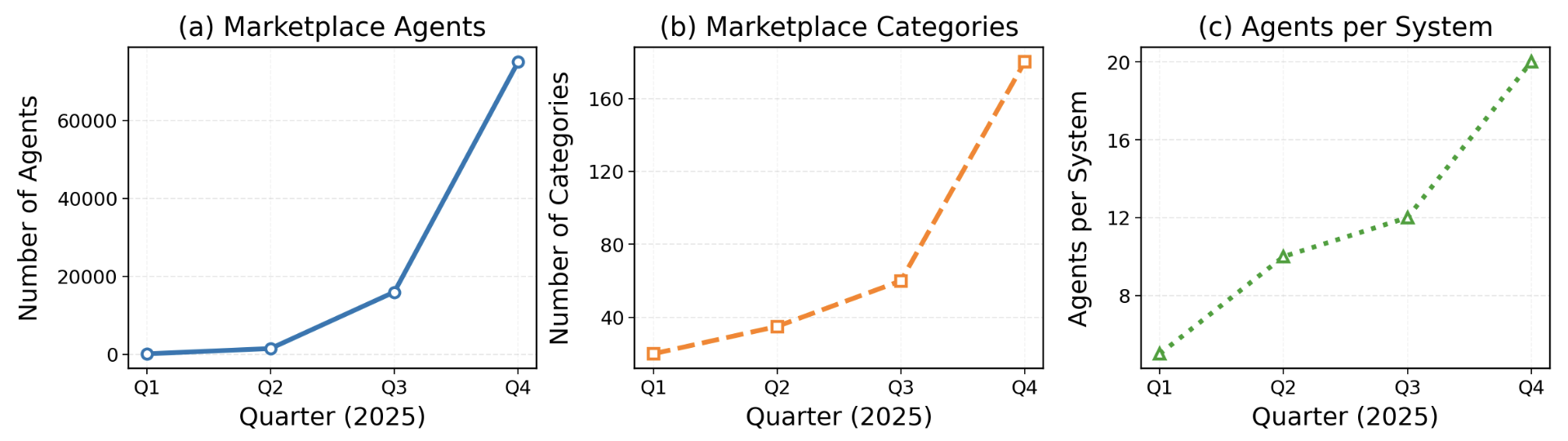
多智能体系统(MAS)通过调度日益庞大的智能体与工具市场来解决复杂任务。随着市场扩展,大量候选者功能重叠,选择不仅涉及检索,还需考虑可靠性、上下文兼容性及协作能力。现有推荐系统难以应对智能体编排的结构化、序列化和依赖性特征。本文将智能体推荐建模为带约束的决策问题,提出一个通用的约束推荐框架:先通过检索构建与当前子任务和上下文相关的紧凑候选集,再利用学习评分器在可行集中进行效用优化,综合考量相关性、可靠性和交互效应。框架以历史调用树为依据,捕捉父-子调用、分支依赖和局部协作模式,超越传统扁平日志。支持两种互补设置:智能体级推荐(选择下一个智能体)与系统级推荐(选出可协同执行的小型连接智能体子图)。为实现系统评估,我们从八个异构多智能体语料库中归一化调用日志,构建统一的调用树基准数据集。
原文摘要 · Abstract (English)
Multi-agent systems (MAS) increasingly solve complex tasks by orchestrating agents and tools selected from rapidly growing marketplaces. As these marketplaces expand, many candidates become functionally overlapping, making selection not just a retrieval problem: beyond filtering relevant agents, an orchestrator must choose options that are reliable, compatible with the current execution context, and able to cooperate with other selected agents. Existing recommender systems -- largely built for item-level ranking from flat user-item logs -- do not directly address the structured, sequential, and interaction-dependent nature of agent orchestration. We address this gap by \textbf{formulating agent recommendation in MAS as a constrained decision problem} and introducing a generic \textbf{constrained recommendation framework} that first uses retrieval to build a compact candidate set conditioned on the current subtask and context, and then performs \textbf{utility optimization} within this feasible set using a learned scorer that accounts for relevance, reliability, and interaction effects. We ground both the formulation and learning signals in \textbf{historical calling trees}, which capture the execution structure of MAS (parent-child calls, branching dependencies, and local cooperation patterns) beyond what flat logs provide. The framework supports two complementary settings: \textbf{agent-level recommendation} (select the next agent/tool) and \textbf{system-level recommendation} (select a small, connected agent team/subgraph for coordinated execution). To enable systematic evaluation, we construct a unified calling-tree benchmark by normalizing invocation logs from eight heterogeneous multi-agent corpora into a shared structured representation.
Thank you to arXiv for use of its open access interoperability. PaperDance 不是 arXiv 官方产品;中文卡片由大模型生成,请以原文为准。