用随机动力学与流形学习结合,提升癫痫发作前的预警灵敏度。
Early warning prediction: Onsager-Machlup vs Schrödinger
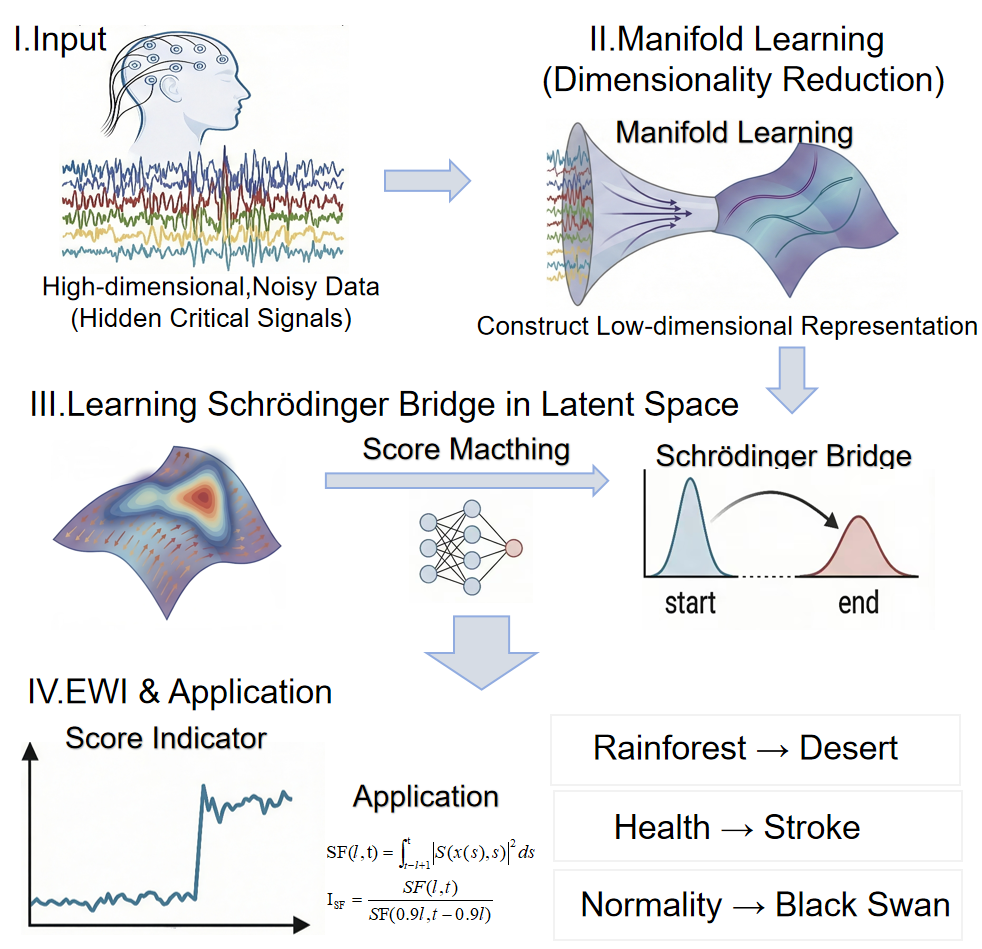
- 通过流形学习降维,构建数据驱动的随机微分方程模型。
- 新提出的评分函数在癫痫预测中更早识别临界点,敏感性更高。
- 适合高维复杂系统预警研究,尤其适用于脑电等生理信号分析。
预测复杂系统中的临界转变,如大脑中的癫痫发作,是科学领域的重大挑战。高维特征与隐藏的关键信号进一步增加了早期预警的难度。本研究提出一种融合流形学习与随机动力系统建模的新预警框架。通过系统比较,从六种方法(包括扩散映射,DM)中选取最优方案,构建低维表示;在此基础上,建立数据驱动的随机微分方程模型,稳健估计系统概率演化评分函数。基于此,引入舒尔丁格桥理论定义新的评分函数(SF),量化系统发生显著状态跃迁的可能性。实验表明,该指标在癫痫预测中表现出更高的灵敏度与鲁棒性,能更早识别临界点,并清晰捕捉发作前后各阶段的动态特征。本工作为从高维数据中提取早期预警信号提供了系统的理论框架与实用方法。
原文摘要 · Abstract (English)
Predicting critical transitions in complex systems, such as epileptic seizures in the brain, represents a major challenge in scientific research. The high-dimensional characteristics and hidden critical signals further complicate early-warning tasks. This study proposes a novel early-warning framework that integrates manifold learning with stochastic dynamical system modeling. Through systematic comparison, six methods including diffusion maps (DM) are selected to construct low-dimensional representations. Based on these, a data-driven stochastic differential equation model is established to robustly estimate the probability evolution scoring function of the system. Building on this, a new Score Function (SF) indicator is defined by incorporating Schrödinger bridge theory to quantify the likelihood of significant state transitions in the system. Experiments demonstrate that this indicator exhibits higher sensitivity and robustness in epilepsy prediction, enables earlier identification of critical points, and clearly captures dynamic features across various stages before and after seizure onset. This work provides a systematic theoretical framework and practical methodology for extracting early-warning signals from high-dimensional data.
Thank you to arXiv for use of its open access interoperability. PaperDance 不是 arXiv 官方产品;中文卡片由大模型生成,请以原文为准。