自动增强对比学习提升可穿戴设备动作识别准确率
Auto-Augmentation Contrastive Learning for Wearable-based Human Activity Recognition
- 基于孪生网络自动生成数据增强策略
- 在四个数据集上显著优于现有最先进方法
- 适合无标注数据下的可穿戴动作识别研究
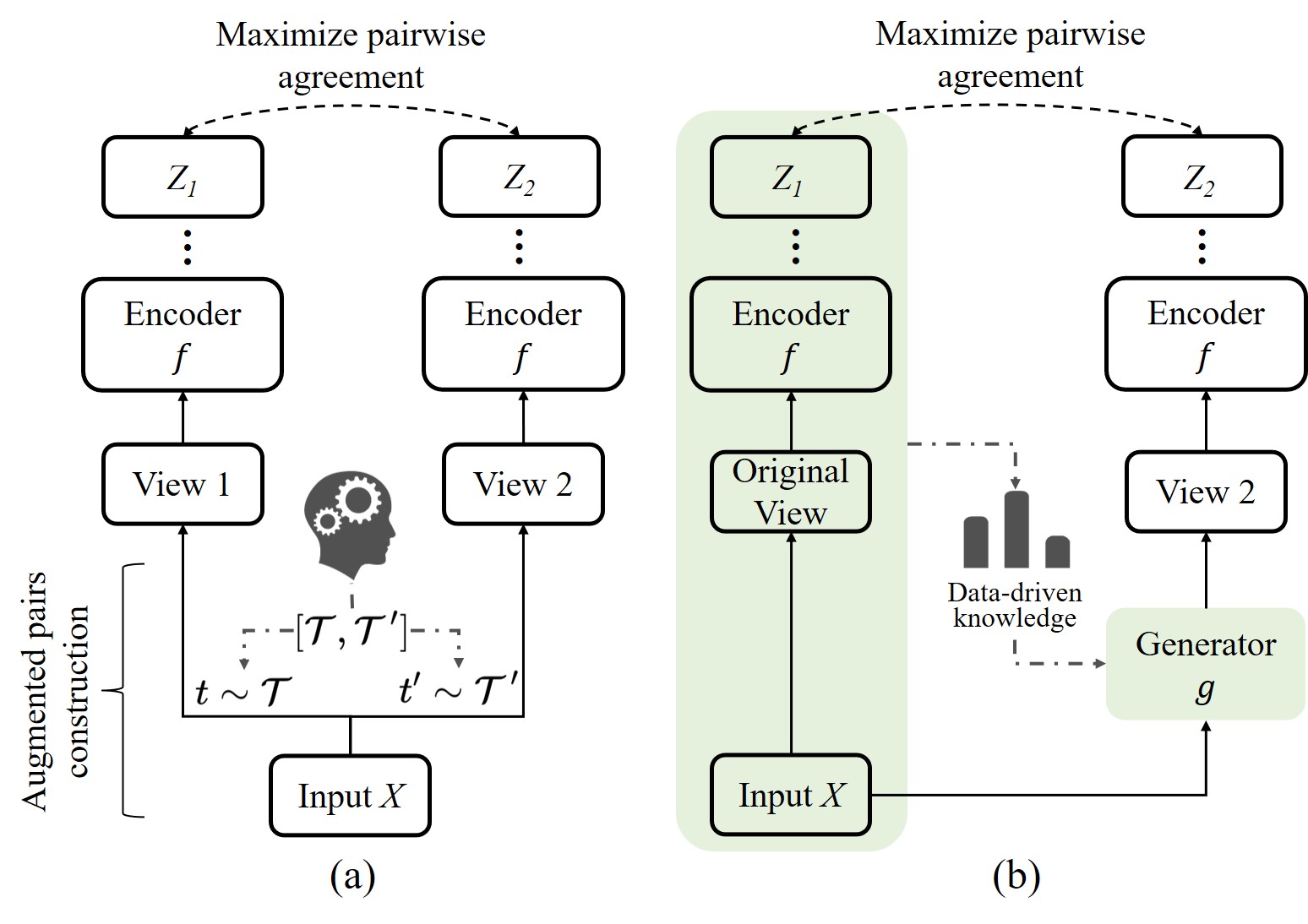
针对可穿戴设备人体动作识别(HAR)中语义较低的传感器信号,对比学习(CL)是实现无监督模型的关键技术。然而,传统对比学习高度依赖人工设计的数据增强策略,尤其在低语义的HAR任务中,缺乏通用性和灵活性。为此,本文提出端到端的自动增强对比学习(AutoCL)方法,基于共享主干网络的孪生结构,并嵌入生成器以自动学习增强策略。AutoCL利用潜在空间表示训练生成器,有效抑制原始数据中的噪声和冗余信息干扰。此外,通过引入梯度停止设计与相关性降低策略,进一步提升编码器表征能力。在四个主流HAR数据集上的大量实验表明,该方法相比现有SOTA方法显著提升了识别准确率。
原文摘要 · Abstract (English)
For low-semantic sensor signals from human activity recognition (HAR), contrastive learning (CL) is essential to implement novel applications or generic models without manual annotation, which is a high-performance self-supervised learning (SSL) method. However, CL relies heavily on data augmentation for pairwise comparisons. Especially for low semantic data in the HAR area, conducting good performance augmentation strategies in pretext tasks still rely on manual attempts lacking generalizability and flexibility. To reduce the augmentation burden, we propose an end-to-end auto-augmentation contrastive learning (AutoCL) method for wearable-based HAR. AutoCL is based on a Siamese network architecture that shares the parameters of the backbone and with a generator embedded to learn auto-augmentation. AutoCL trains the generator based on the representation in the latent space to overcome the disturbances caused by noise and redundant information in raw sensor data. The architecture empirical study indicates the effectiveness of this design. Furthermore, we propose a stop-gradient design and correlation reduction strategy in AutoCL to enhance encoder representation learning. Extensive experiments based on four wide-used HAR datasets demonstrate that the proposed AutoCL method significantly improves recognition accuracy compared with other SOTA methods.
Thank you to arXiv for use of its open access interoperability. PaperDance 不是 arXiv 官方产品;中文卡片由大模型生成,请以原文为准。