用脉冲神经网络解析脑电图,揭示阿尔茨海默病的神经机制。
Learning Alzheimer's Disease Signatures by bridging EEG with Spiking Neural Networks and Biophysical Simulations
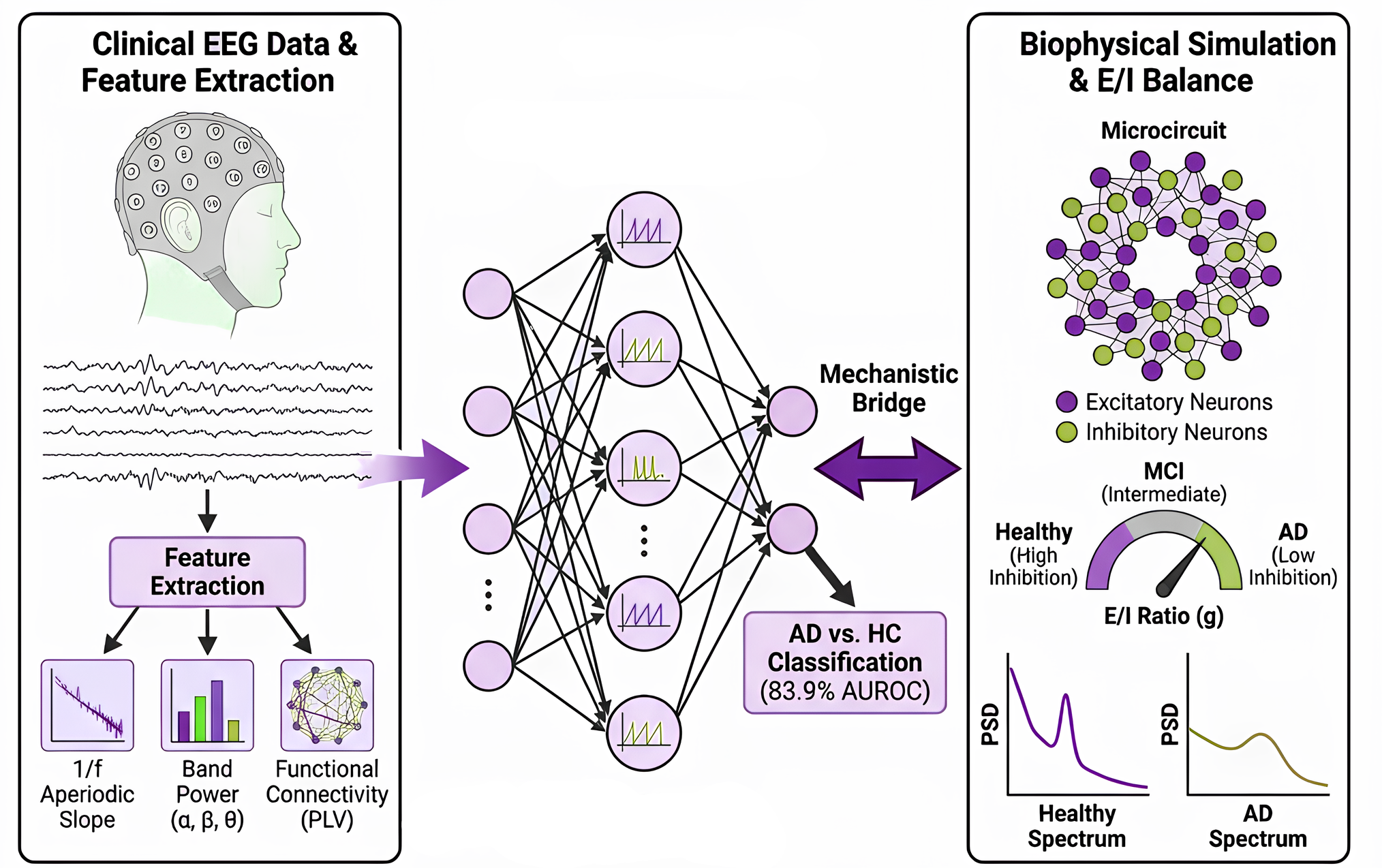
- 构建神经桥框架,将脑电数据与生物物理模拟结合。
- 识别1/f斜率是关键判别特征,反映兴奋抑制失衡。
- 适合关注脑电机制解释与可解释性诊断的研究者。
随着阿尔茨海默病(AD)患病率上升,从非侵入性生物标志物中获取机制性洞察变得愈发重要。近期研究表明,电路水平的脑改变会以脑电图(EEG)频谱特征的变化体现,可被机器学习检测。然而,传统深度学习方法计算量大且机制不透明。脉冲神经网络(SNNs)提供了生物合理且能效更高的替代方案,但其在AD诊断中的应用仍较少。本文提出一种神经桥框架,将数据驱动学习与最小化、基于生物物理的模拟相结合,实现机器学习特征与AD电路机制间的双向解释。基于静息态临床脑电图,训练的SNN分类器达到优异性能(AUC = 0.839),并识别出1/f斜率是关键判别特征,反映兴奋-抑制平衡变化。通过系统调整抑制性到兴奋性突触比例,构建脉冲网络模拟健康、轻度认知障碍及AD样状态。采用膜电位和突触电流两类脑电代理,重现了经验性的频谱减慢与α波组织改变。在多子网络模拟中引入经验功能连接先验,进一步增强了频谱区分能力,表明大规模网络拓扑对脑电特征的约束强于兴奋-抑制平衡本身。整体上,该神经桥方法将SNN分类结果与可解释的电路模拟相连,推进了对脑电生物标志物的机制理解,并实现了可扩展、可解释的AD检测。
原文摘要 · Abstract (English)
As the prevalence of Alzheimer's disease (AD) rises, improving mechanistic insight from non-invasive biomarkers is increasingly critical. Recent work suggests that circuit-level brain alterations manifest as changes in electroencephalography (EEG) spectral features detectable by machine learning. However, conventional deep learning approaches for EEG-based AD detection are computationally intensive and mechanistically opaque. Spiking neural networks (SNNs) offer a biologically plausible and energy-efficient alternative, yet their application to AD diagnosis remains largely unexplored. We propose a neuro-bridge framework that links data-driven learning with minimal, biophysically grounded simulations, enabling bidirectional interpretation between machine learning signatures and circuit-level mechanisms in AD. Using resting-state clinical EEG, we train an SNN classifier that achieves competitive performance (AUC = 0.839) and identifies the aperiodic 1/f slope as a key discriminative marker. The 1/f slope reflects excitation-inhibition balance. To interpret this mechanistically, we construct spiking network simulations in which inhibitory-to-excitatory synaptic ratios are systematically varied to emulate healthy, mild cognitive impairment, and AD-like states. Using both membrane potential-based and synaptic current-based EEG proxies, we reproduce empirical spectral slowing and altered alpha organization. Incorporating empirical functional connectivity priors into multi-subnetwork simulations further enhances spectral differentiation, demonstrating that large-scale network topology constrains EEG signatures more strongly than excitation-inhibition balance alone. Overall, this neuro-bridge approach connects SNN-based classification with interpretable circuit simulations, advancing mechanistic understanding of EEG biomarkers while enabling scalable, explainable AD detection.
Thank you to arXiv for use of its open access interoperability. PaperDance 不是 arXiv 官方产品;中文卡片由大模型生成,请以原文为准。