让大模型智能判断哪些记忆该留,提升任务效率与成功率
PABU: Progress-Aware Belief Update for Efficient LLM Agents
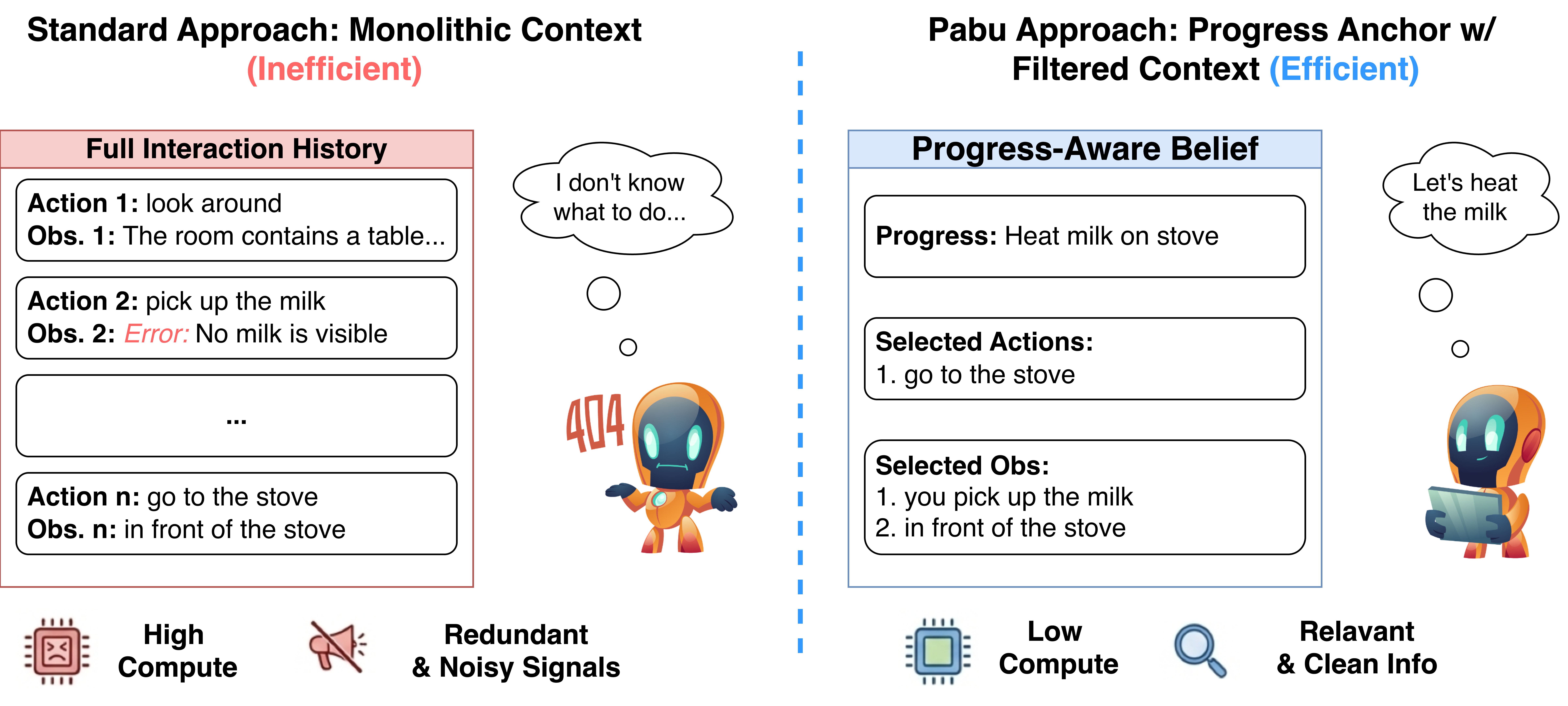
- 通过预测任务进展,只保留关键交互信息
- 在八种环境中任务完成率达81.0%,比以往方法高23.9%
- 平均交互步数降至9.5,减少26.9%的推理开销
大型语言模型(LLM)代理通常依赖完整的动作-观测历史来决定行为,这引入了无关信息,易导致冗余操作和更高的推理成本。本文提出进度感知信念更新(PABU),一种信念状态框架,通过显式建模任务进展并选择性保留过往动作与观测,紧凑地表示代理状态。每一步中,代理预测自上一轮以来的相对进展,并决定是否存储新遇到的交互,仅基于保留子集进行未来决策。在AgentGym基准的八个环境中,使用相同的训练轨迹,PABU实现81.0%的任务完成率,优于以往采用全历史信念的最先进模型23.9%。此外,以进展为导向的动作选择提升了效率,平均交互步数降至9.5,对应26.9%的减少。消融实验表明,显式进度预测与选择性保留对鲁棒信念学习和性能提升均至关重要。
原文摘要 · Abstract (English)
Large Language Model (LLM) agents commonly condition actions on full action-observation histories, which introduce task-irrelevant information that easily leads to redundant actions and higher inference cost. We propose Progress-Aware Belief Update (PABU), a belief-state framework that compactly represents an agent's state by explicitly modeling task progress and selectively retaining past actions and observations. At each step, the agent predicts its relative progress since the previous round and decides whether the newly encountered interaction should be stored, conditioning future decisions only on the retained subset. Across eight environments in the AgentGym benchmark, and using identical training trajectories, PABU achieves an 81.0% task completion rate, outperforming previous State of the art (SoTA) models with full-history belief by 23.9%. Additionally, PABU's progress-oriented action selection improves efficiency, reducing the average number of interaction steps to 9.5, corresponding to a 26.9% reduction. Ablation studies show that both explicit progress prediction and selective retention are necessary for robust belief learning and performance gains.
Thank you to arXiv for use of its open access interoperability. PaperDance 不是 arXiv 官方产品;中文卡片由大模型生成,请以原文为准。