让分割模型学会修复低质图像,直接在模糊图上精准分像素。
Restoration Adaptation for Semantic Segmentation on Low Quality Images
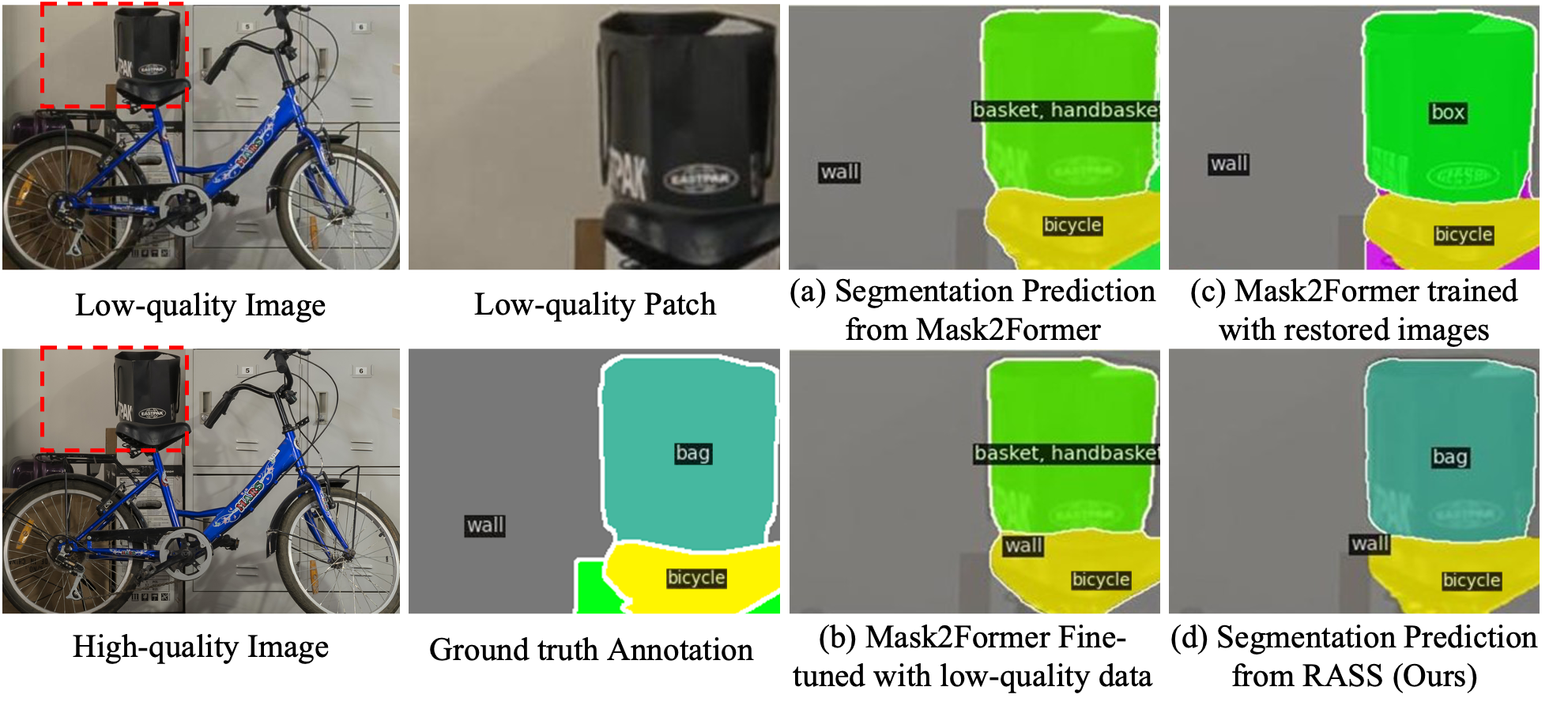
- 用分割掩码引导图像修复,确保恢复内容语义正确。
- 在合成与真实低质图像上,分割精度显著超越现有方法。
- 适合处理手机拍摄、老旧影像等现实场景的图像分割任务。
现实场景中,低质量(LQ)图像因缺乏清晰语义结构和高频细节,导致语义分割性能下降。尽管图像修复技术有望提升视觉质量,但传统真实世界图像修复(Real-IR)模型侧重像素级保真,难以恢复任务相关的语义线索,限制其在下游视觉任务中的应用。而现有基于高质量数据训练的分割模型对真实退化不鲁棒。本文提出用于语义分割的修复自适应框架(RASS),将语义图像修复融入分割流程,实现直接在低质图像上进行高质量分割。首先提出语义约束修复(SCR)模型,通过对齐交叉注意力图与分割掩码,注入分割先验,促进语义一致的图像重建。随后,RASS通过基于LoRA的模块融合与任务特定微调,将语义修复知识迁移至分割模型,增强其对低质图像的鲁棒性。为验证有效性,构建了带有高质量标注的真实世界低质图像分割数据集,并在合成与真实退化基准上开展大量实验。结果表明,SCR与RASS在分割与修复任务中均显著优于现有最先进方法。代码、模型与数据集将开源于https://github.com/Ka1Guan/RASS.git。
原文摘要 · Abstract (English)
In real-world scenarios, the performance of semantic segmentation often deteriorates when processing low-quality (LQ) images, which may lack clear semantic structures and high-frequency details. Although image restoration techniques offer a promising direction for enhancing degraded visual content, conventional real-world image restoration (Real-IR) models primarily focus on pixel-level fidelity and often fail to recover task-relevant semantic cues, limiting their effectiveness when directly applied to downstream vision tasks. Conversely, existing segmentation models trained on high-quality data lack robustness under real-world degradations. In this paper, we propose Restoration Adaptation for Semantic Segmentation (RASS), which effectively integrates semantic image restoration into the segmentation process, enabling high-quality semantic segmentation on the LQ images directly. Specifically, we first propose a Semantic-Constrained Restoration (SCR) model, which injects segmentation priors into the restoration model by aligning its cross-attention maps with segmentation masks, encouraging semantically faithful image reconstruction. Then, RASS transfers semantic restoration knowledge into segmentation through LoRA-based module merging and task-specific fine-tuning, thereby enhancing the model's robustness to LQ images. To validate the effectiveness of our framework, we construct a real-world LQ image segmentation dataset with high-quality annotations, and conduct extensive experiments on both synthetic and real-world LQ benchmarks. The results show that SCR and RASS significantly outperform state-of-the-art methods in segmentation and restoration tasks. Code, models, and datasets will be available at https://github.com/Ka1Guan/RASS.git.
Thank you to arXiv for use of its open access interoperability. PaperDance 不是 arXiv 官方产品;中文卡片由大模型生成,请以原文为准。