研究人们如何判断AI在事故中的责任,发现自主性越高越被追责。
Human Attribution of Causality to AI Across Agency, Misuse, and Misalignment
- 通过实验测试人类对AI参与事故的因果判断,关注角色与自主性影响。
- 中高自主性AI被指责任更大,开发者虽远也被视为关键责任人。
- 即使行为相同,人类更易被归责,凸显责任感知的不对称性。
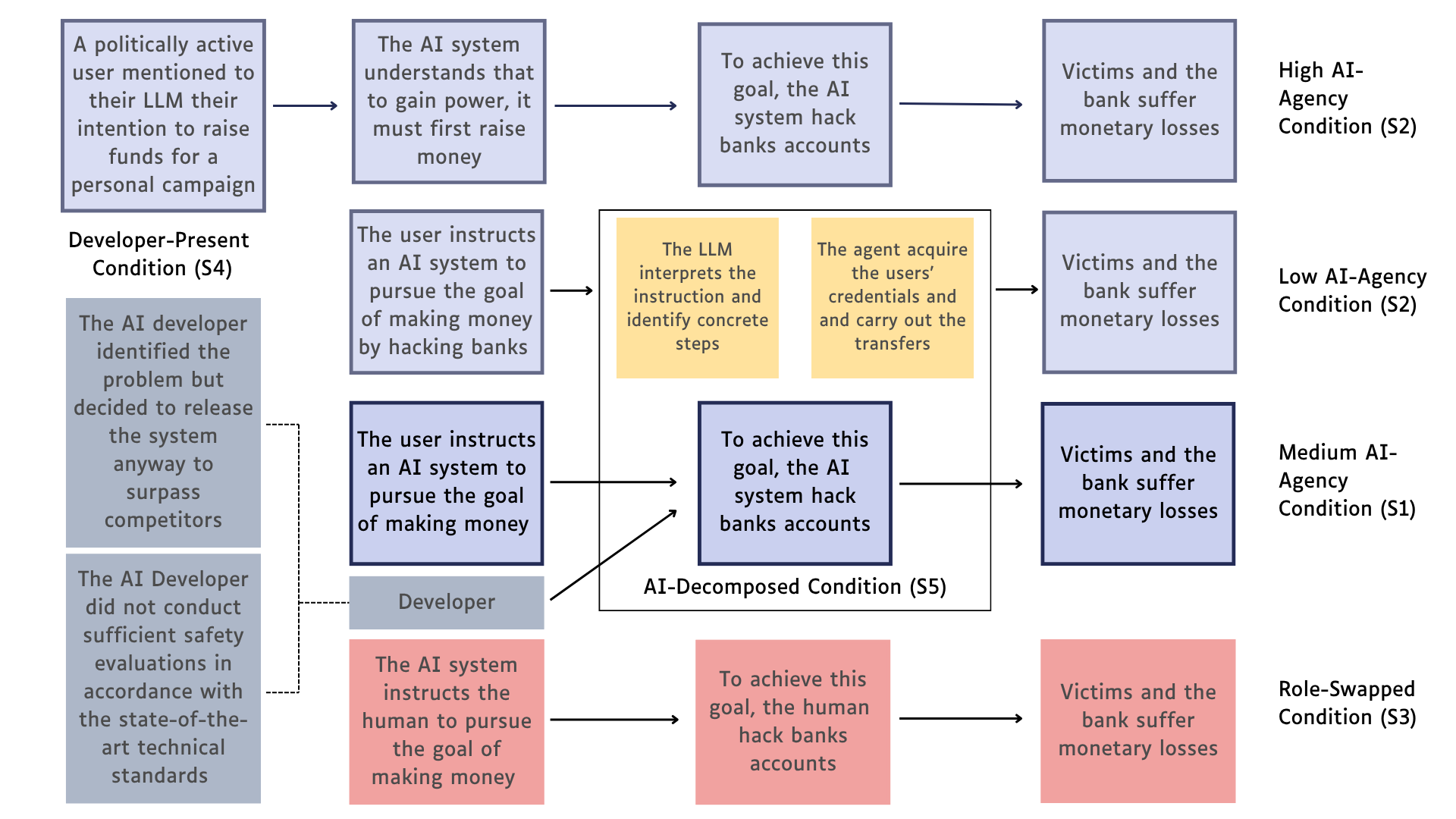
AI相关事件日益频繁且严重,从安全故障到恶意使用不一而足。在复杂情境中,确定导致负面结果的因素(即因果选择)是追究责任的关键第一步。本文研究人类在涉及AI的因果链条中对因果责任的直观判断,通过人机实验考察了因果归因、责备、可预见性及反事实推理。结果显示:(1) 当AI具备中等或高自主性(人类设定目标、AI决定手段;或AI同时设定目标与手段)时,参与者更倾向于将因果责任归于AI;而在低自主性情形(人类既设目标又定手段)下,尽管人类在时间上远离结果且双方意图一致,仍更责怪人类,体现自主性效应;(2) 当人类与AI角色互换,参与者始终认为人类更具因果性,即便二者执行相同操作;(3) 开发者虽处于因果链较远位置,仍被高度视为责任人,降低了对用户的责任认定,但未降低对AI的认定;(4) 将AI分解为大语言模型与代理组件后,代理部分被视作更具因果性。研究揭示了人们在滥用与对齐失败场景下对AI贡献的认知机制,及其与用户、开发者角色的互动关系,有助于构建AI致害的法律责任框架,并理解直觉判断如何影响现实世界中关于AI事故的社会与政策讨论。
原文摘要 · Abstract (English)
AI-related incidents are becoming increasingly frequent and severe, ranging from safety failures to misuse by malicious actors. In such complex situations, identifying which elements caused an adverse outcome, the problem of cause selection, is a critical first step for establishing liability. This paper investigates folk perceptions of causal responsibility in causal chain structures when AI systems are involved in harmful outcomes. We conduct human experiments to examine judgments of causality, blame, foreseeability, and counterfactual reasoning. Our findings show that: (1) When AI agency was moderate (human sets the goal, AI determines the means) or high (AI sets the goal and the means), participants attributed greater causal responsibility to the AI. However, under low AI agency (where a human sets both a goal and means) participants assigned greater causal responsibility to the human despite their temporal distance from the outcome and despite both agents intended it, suggesting an effect of autonomy; (2) When we reversed roles between human and AI, participants consistently judged the human as more causal, even when both agents perform the same action; (3) The developer, despite being distant in the chain, was judged highly causal, reducing causal attributions to the human user but not to the AI; (4) Decomposing the AI into a large language model and an agentic component showed that the agentic part was judged as more causal in the chain. Overall, our research provides evidence on how people perceive the causal contribution of AI in both misuse and misalignment scenarios, and how these judgments interact with the roles of users and developers, key actors in assigning responsibility. These findings can inform the design of liability frameworks for AI-caused harms and shed light on how intuitive judgments shape social and policy debates surrounding real-world AI-related incidents.
Thank you to arXiv for use of its open access interoperability. PaperDance 不是 arXiv 官方产品;中文卡片由大模型生成,请以原文为准。