可穿戴心电设备+算法,用普通心电图区分遗传性与后天性心肌肥厚。
A Wearable ECG Device for Differentiating Hypertrophic Cardiomyopathy from Acquired Left Ventricular Hypertrophy
- 通过提取心跳信号中的两个量化指标,用双阈值统计方法分类。
- 在483例患者数据上实现75.86%敏感性、99.17%特异性。
- 硬件兼容性强,适合资源匮乏地区低成本筛查。
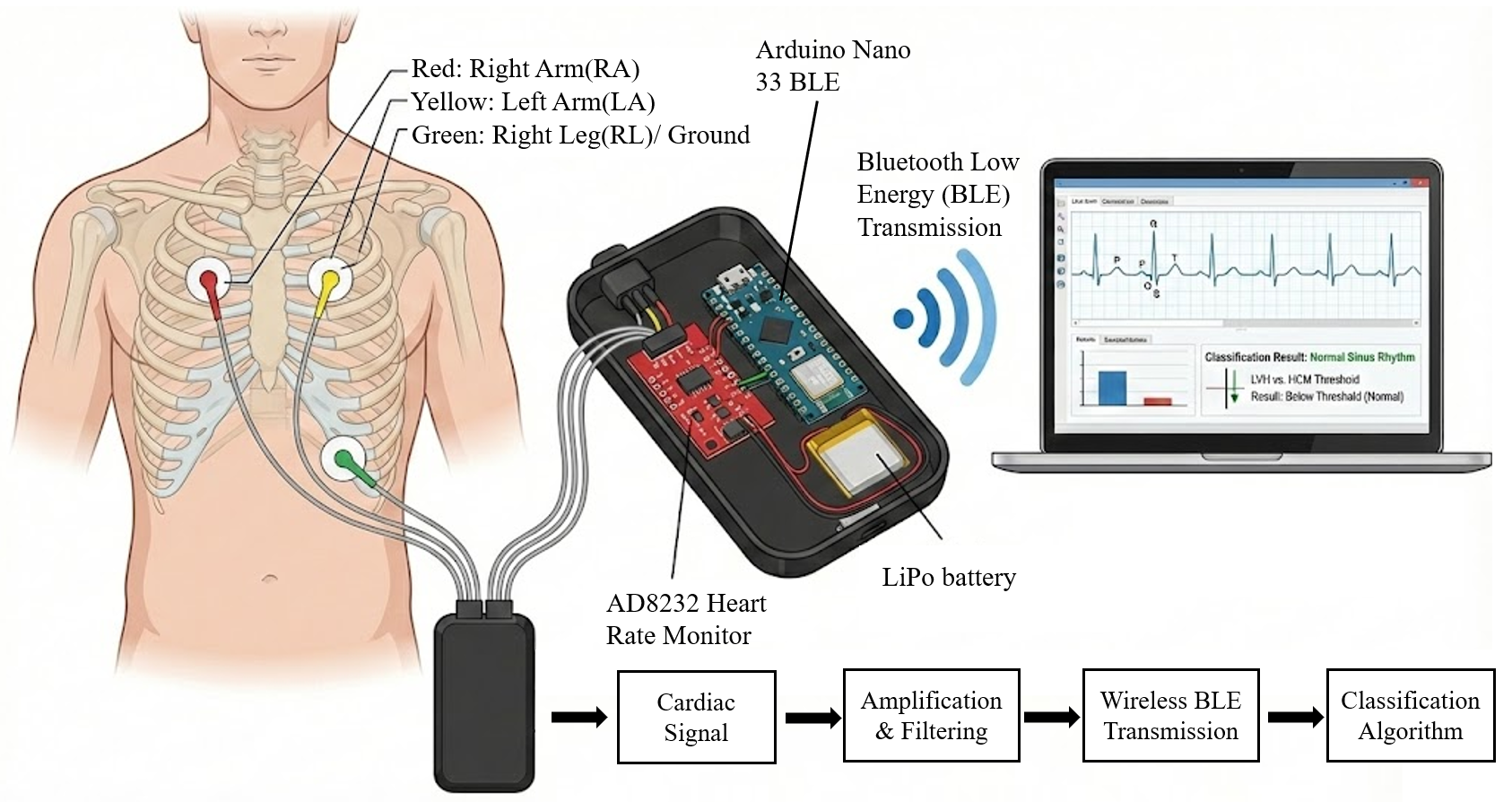
肥厚型心肌病(HCM)是每500人中约1人患病的遗传性心脏病,也是年轻运动员突发心脏死亡的主要原因。现有诊断手段——心血管磁共振、超声心动图和基因检测——受限于高成本、操作依赖性或准确性不足,而标准心电图无法可靠区分HCM与后天性左室肥厚(LVH)。本文提出一种可穿戴式心电设备,结合分类算法,仅凭心电图信号即可区分两者。该便携设备集成三导联电极系统、AD8232信号调理模块、Arduino Nano 33 BLE微控制器及锂电池。算法从每个心跳中提取两个定量指标——HCM Index₁ 和 HCM Index₂——并基于双统计阈值进行分类。在483例LVH患者(PhysioNet)和29例HCM患者(数字化临床记录)数据集上验证,敏感性为75.86%,特异性达99.17%,F1分数为80.00%。留一法交叉验证确认泛化能力,交叉验证结果为:敏感性72.41%,特异性98.96%,F1分数76.36%(95%置信区间已报告)。数字源混淆分析表明分类结果由生理特征驱动,而非数据来源伪影。模拟设备采集链分析证实,可穿戴硬件的信号特性与分类算法兼容。该系统为资源有限环境下的低成本HCM筛查提供了有前景的工具。
原文摘要 · Abstract (English)
Hypertrophic Cardiomyopathy (HCM) is a genetic heart disease affecting approximately 1 in 500 people and is the leading cause of sudden cardiac death in young athletes. Current diagnostic methods -- cardiovascular magnetic resonance (CMR), echocardiography, and genetic testing -- are limited by high costs, operator dependency, or insufficient accuracy, while standard electrocardiogram (ECG) analysis cannot reliably distinguish HCM from acquired left ventricular hypertrophy (LVH). This paper presents a wearable ECG device paired with a classification algorithm that differentiates HCM from acquired LVH using ECG signals alone. The portable device integrates a 3-lead electrode system, an AD8232 signal conditioning module, an Arduino Nano 33 BLE microcontroller, and a lithium polymer battery. The algorithm extracts two quantitative indices -- HCM Index~1 and HCM Index~2 -- from each heartbeat and classifies patients via dual statistical thresholds. Validation on 483 LVH patients (PhysioNet) and 29 HCM patients (digitized clinical records) yields 75.86\% sensitivity, 99.17\% specificity, and an F1-score of 80.00\%. Leave-one-out cross-validation confirms generalizability, with cross-validated sensitivity of 72.41\%, specificity of 98.96\%, and F1-score of 76.36\% (95\% confidence intervals reported). A digitization confound analysis demonstrates that the classification is driven by physiological cardiac features rather than data source artifacts. A simulated device acquisition chain analysis confirms that the wearable hardware's signal characteristics are compatible with the classification algorithm. The system offers a promising tool for affordable HCM screening in resource-limited settings.
Thank you to arXiv for use of its open access interoperability. PaperDance 不是 arXiv 官方产品;中文卡片由大模型生成,请以原文为准。