通过特征白化提升脑影像线性模型的临床可解释性
Improving clinical interpretability of linear neuroimaging models through feature whitening
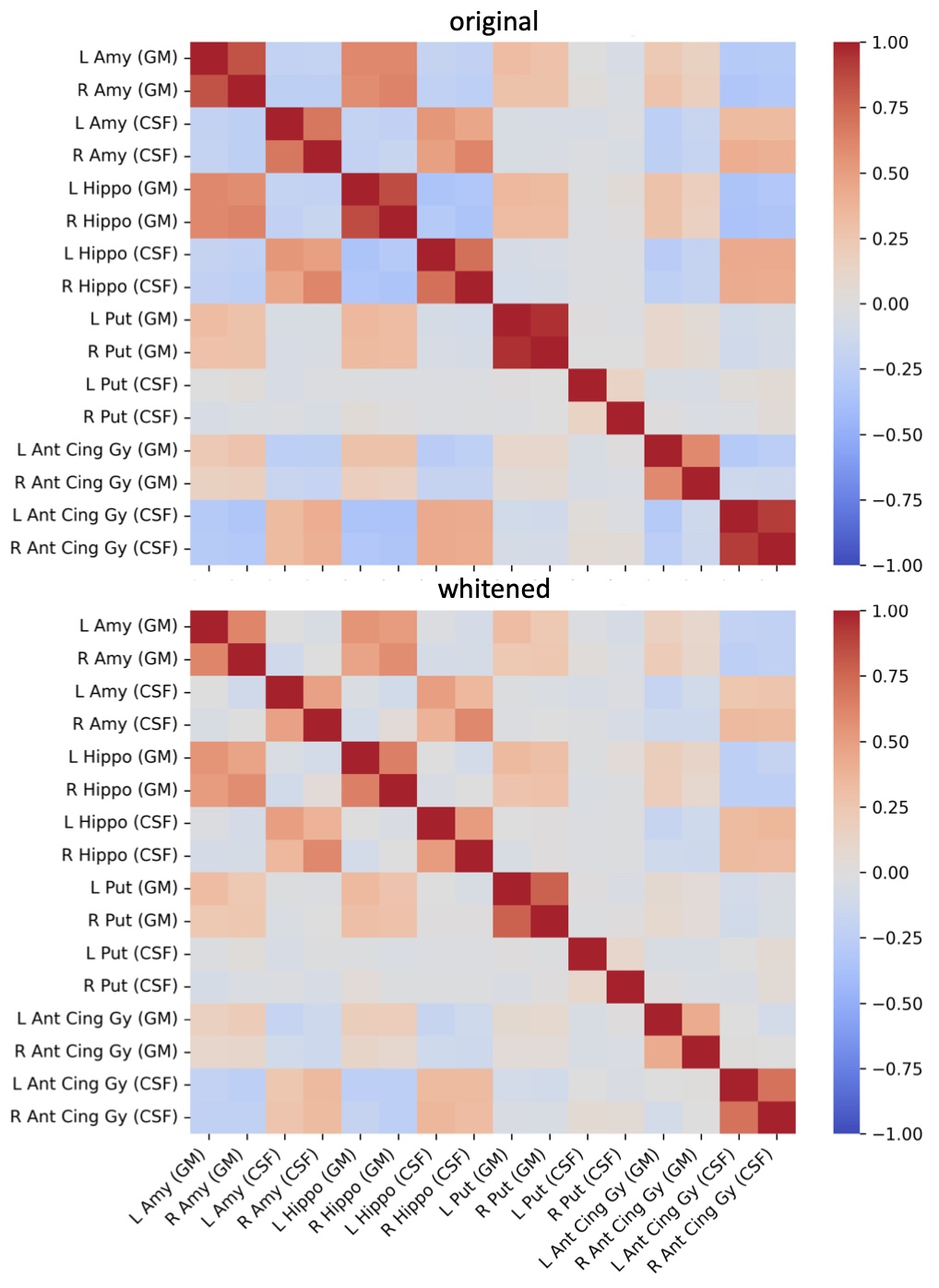
- 针对脑区相关性导致权重混淆,对成对脑区进行解相关白化
- 在双相障碍和精神分裂症分类中保持预测性能的同时提升可解释性
- 适合关注模型生物学意义的临床神经科学研究人员
线性模型广泛用于计算神经影像学中识别与脑病理相关的生物标志物,但其学习到的权重难以提供临床有意义的洞察。这一困难部分源于脑区间的固有相关性,导致权重反映的是共享而非区域特异性贡献。特别地,左右半球的同源结构表现出强烈的解剖相关性。本文利用这一先验神经解剖知识,提出一种应用于已知共享方差脑区组的白化方法,旨在解耦相关脑测量值间的重叠信息。我们还提出一种正则化变体,可控制去相关程度。在两个精神病分类任务中使用感兴趣区特征进行评估:区分双相障碍或精神分裂症患者与健康对照。与主成分分析(PCA)或独立成分分析(ICA)将白化作为降维步骤不同,本方法在保留完整输入信号的前提下,对解剖上相关的脑区对进行去相关处理,更适用于特征解释而非特征选择。结果表明,白化在保持预测性能的同时显著提升了模型权重的可解释性,为线性模型输出与神经生物学机制的关联提供了稳健框架。
原文摘要 · Abstract (English)
Linear models are widely used in computational neuroimaging to identify biomarkers associated with brain pathologies. However, interpreting the learned weights remains challenging, as they do not always yield clinically meaningful insights. This difficulty arises in part from the inherent correlation between brain regions, which causes linear weights to reflect shared rather than region-specific contributions. In particular, some groups of regions, including homologous structures in the left and right hemispheres, are known to exhibit strong anatomical correlations. In this work, we leverage this prior neuroanatomical knowledge to introduce a whitening approach applied to groups of regions with known shared variance, designed to disentangle overlapping information across correlated brain measures. We additionally propose a regularized variant that allows controlled tuning of the degree of decorrelation. We evaluate this method using region-of-interest features in two psychiatric classification tasks, distinguishing individuals with bipolar disorder or schizophrenia from healthy controls. Importantly, unlike PCA or ICA which use whitening as a dimensionality reduction step, our approach decorrelates anatomically informed pairs of neuroanatomical regions while retaining the full input signal, making it specifically suited for feature interpretation rather than feature selection. Our findings demonstrate that whitening improves the interpretability of model weights while preserving predictive performance, providing a robust framework for linking linear model outputs to neurobiological mechanisms.
Thank you to arXiv for use of its open access interoperability. PaperDance 不是 arXiv 官方产品;中文卡片由大模型生成,请以原文为准。