解决大范围多相机运动捕捉校准难题,提升鲁棒性与可验证性。
Robust Camera-to-Mocap Calibration and Verification for Large-Scale Multi-Camera Data Capture
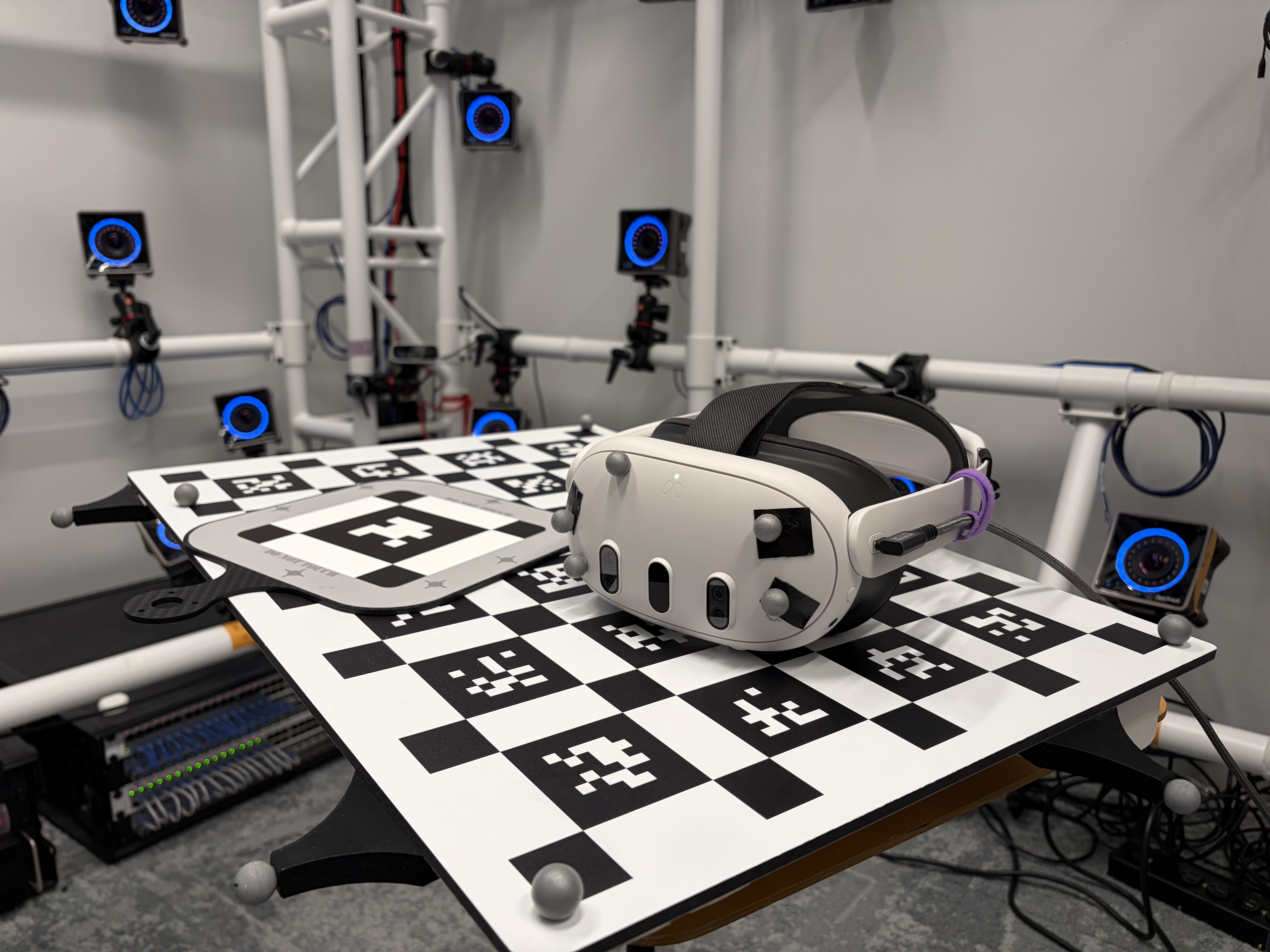
- 联合估计相机外参与标定板到标记点的变换,增强收敛稳定性。
- 在Meta Quest 3上实测精度优于现有方法,且可检测校准漂移。
- 适合需要长期稳定数据采集的AR/VR与机器人研究者使用。
光学动作捕捉系统广泛用于AR/VR、SLAM和机器人数据集的真实姿态采集。这些数据集需通过外参校准将动捕坐标系对齐外部相机帧,但实际中易受多种误差影响,故障常在下游数据污染后才被发现。该问题在鱼眼相机场景下更严重,因其空间非均匀畸变使校准与验证更具挑战性。本文提出一套面向此场景的校准与验证系统。具体而言,针对标定板与标记点装配差异、优化初始值模糊及部署后会话间校准漂移问题,系统联合估计相机外参与板到标记的变换,并采用分阶段求解器提升初始化模糊下的收敛可靠性。验证模块\lollypop通过完全独立于校准数据的测量链实现快速、无需人工干预的评估。在配备鱼眼相机的Meta Quest 3头戴设备上实验表明,本校准方法性能超越现有基准,\lollypop能可靠检测随时间演化的校准退化。该系统已投入生产级数据采集流程。
原文摘要 · Abstract (English)
Optical motion capture (mocap) systems are widely used for ground-truth capture in AR/VR, SLAM and robotics datasets. These datasets require extrinsic calibration to align mocap coordinates to external camera frames -- a step that is subject to multiple sources of error in practice, and failures often go undetected until they corrupt downstream data. These issues are compounded for fisheye cameras, where spatially non-uniform distortion makes both calibration and verification more challenging. We present a calibration and verification system designed for this setting. Concretely, we target robustness to board-to-marker attachment variation, optimization initialization ambiguity, and session-to-session calibration drift after deployment. The calibration jointly estimates camera extrinsics and the board-to-marker transform, and uses a staged solver to improve convergence reliability under ambiguous initialization. The verification component, \lollypop, provides fast, operator-independent assessment through a measurement chain entirely independent of the calibration data. In experiments on a Meta Quest 3 headset with fisheye cameras, our calibration outperforms existing benchwork, and lollypop reliably detects calibration degradation over time. The system has been deployed in production data collection pipelines.
Thank you to arXiv for use of its open access interoperability. PaperDance 不是 arXiv 官方产品;中文卡片由大模型生成,请以原文为准。