用因果数字孪生让语义通信更懂长期目标,提升无人机导航效果。
World Model-Enabled Causal Digital Twins for Semantic Communications in Physical AI Systems
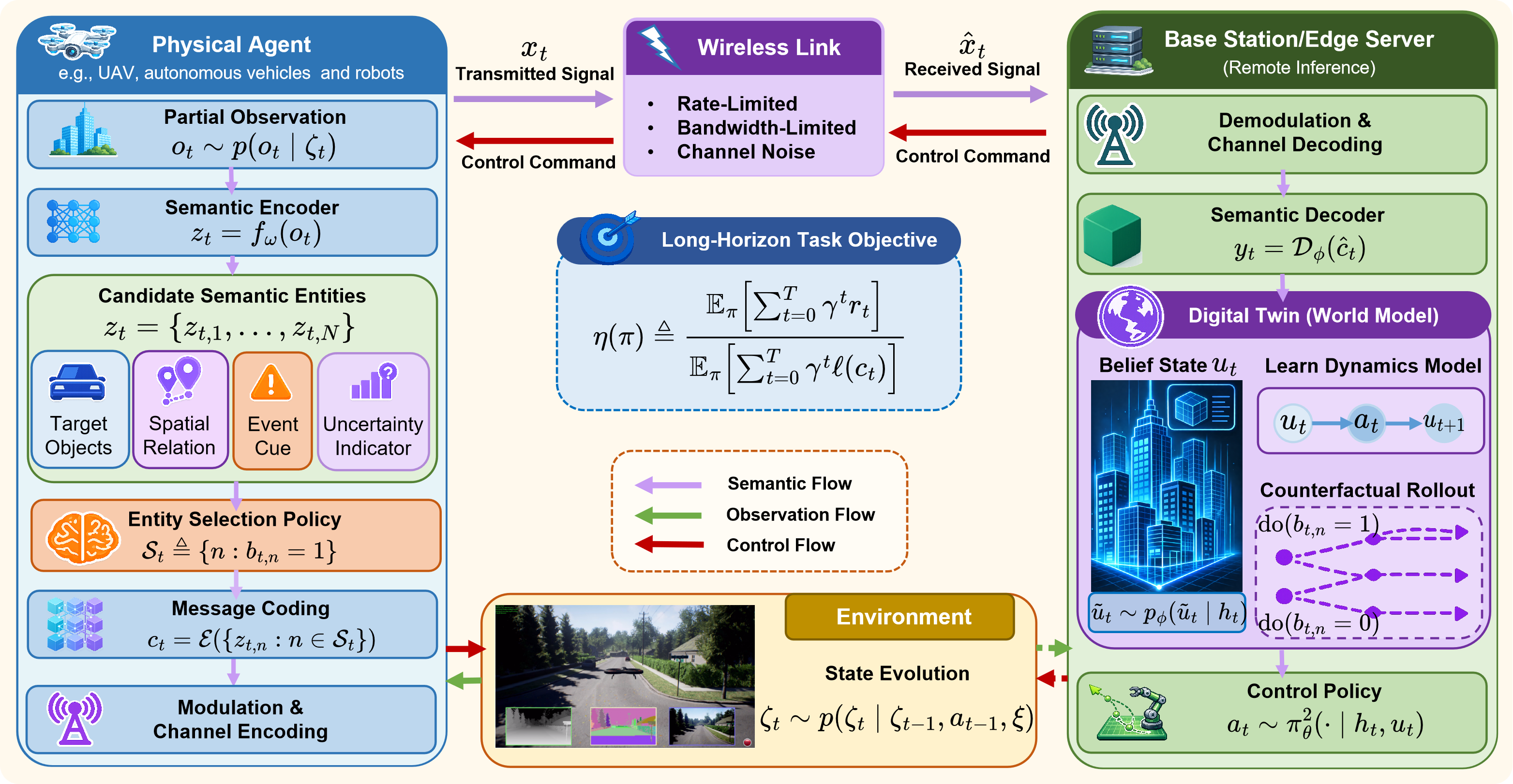
- 基于世界模型构建因果数字孪生,模拟语义传输对长期任务的影响。
- 在无人机导航中实现每千比特回报提升37.5%,成功率提高28%。
- 适合研究物理人工智能闭环系统与高效语义通信的学者。
语义通信作为面向目标的网络新范式备受关注,但现有方案多针对一次性任务,仅优化瞬时性能,无法支撑具有物理人工智能(AI)的闭环动态系统。本文研究闭环感知-通信-推理-控制下的目标导向语义通信,将问题建模为在无线比特预算约束下最大化长期回报/比特。为此提出因果信息价值(CIV)度量,评估每个语义标记对预期长期回报的边际贡献。进一步提出世界模型增强的因果数字孪生(WM-CDT)框架,捕捉闭环物理AI系统的动态演化,支持长周期反事实推演。基于这些推演结果,训练高数据效率的演员-评论家策略用于长期智能体控制,同时通过CIV/比特评估训练语义标记选择器。在AirSim-Sionna-based无人机导航仿真平台上的大量实验表明,该框架相比现有强化学习方案,返回值/千比特提升37.5%,导航成功率提高28%。
原文摘要 · Abstract (English)
Semantic communication has emerged as a promising paradigm for enabling goal-oriented networking. However, most existing semantic communication solutions are tailored to one-shot tasks and optimize instantaneous performance. Hence, they cannot be used to support closed-loop dynamic systems with physical artificial intelligence (AI), in which the transmitted semantics affect not only the current inference outcome but also future control actions, state evolution, and ultimately long-horizon task performance. To address this gap, this paper investigates goal-oriented semantic communications for physical AI systems with closed-loop sensing-communication-inference-control. In particular, the problem of semantic communications is formulated as a long-term return-per-bit maximization under wireless bit-budget constraints while capturing both control efficiency and communication efficiency. To solve this problem, a novel causal information value (CIV) metric is introduced to evaluate the marginal contribution of each semantic token to the expected long-term return by transmission interventions. Then, a world-model-enabled causal digital twin (WM-CDT) framework is proposed to capture the dynamics of closed-loop physical AI systems and enable counterfactual reasoning for long-horizon imagined rollouts. Based on these imagined rollouts, an actor-critic policy is trained for long-horizon agent control with high data efficiency, while the semantic token selector is trained through CIV-per-bit evaluation. Extensive simulations on an AirSim-Sionna-based unmanned aerial vehicle (UAV) navigation simulator show that the proposed WM-CDT framework achieves significant improvement in return-per-kbit and navigation success rate compared to existing reinforcement learning solutions.
Thank you to arXiv for use of its open access interoperability. PaperDance 不是 arXiv 官方产品;中文卡片由大模型生成,请以原文为准。