用少量数据实现毫秒脉冲星噪声的快速精准预测
Few-Shot Prediction for Pulsar Noise with Long Short-Term Memory Network
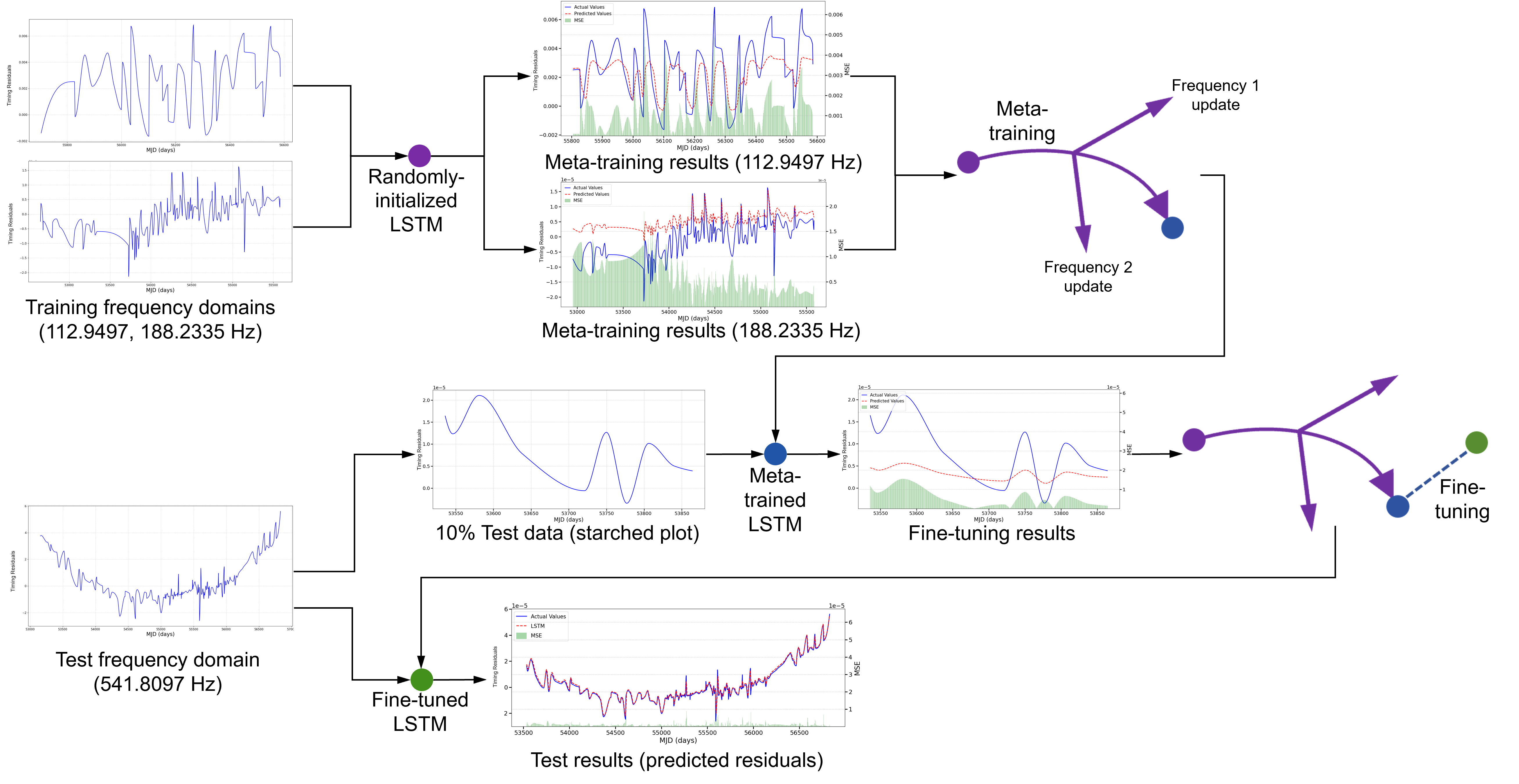
- 基于LSTM与元学习,仅需少量数据即可快速适应新频率域
- 在IPTA二版数据集上三项指标表现优异,仅用10%数据微调
- 模型轻量,单步预测耗时18毫秒,内存占用仅16.86MB
本文针对脉冲星时序阵列(PTA)数据中毫秒脉冲星不同自转频率子组的数据稀缺问题,提出一种新型脉冲星时序残差预测方法。该方法采用经模型无关元学习优化的长短期记忆网络(LSTM),通过仅用少量真实时序残差进行微调,即可快速适应新频率域。同时结合粒子群优化算法自动调节超参数,提升预测精度。在国际脉冲星时序阵列(IPTA)第二数据发布版上的实验表明,该方法在高频测试频段三个指标上均表现出鲁棒性,且仅需10%的对应残差数据用于模型微调。此外,模型结构轻量,单步残差预测仅消耗16.86 MB CPU内存和18毫秒时间,适用于计算资源、内存或能耗受限的真实场景。
原文摘要 · Abstract (English)
This work proposes a novel solution to predict pulsar timing residuals with limited data, addressing the critical challenge of data scarcity across spin-frequency subgroups of millisecond pulsars in PTA datasets. The proposed solution applies a Long Short-Term Memory (LSTM) network optimized using the model-agnostic meta-learning algorithm, enabling rapid adaptation to new frequency domain by fine-tuning the LSTM network with only a few-shot of ground truth timing residuals. Particle swarm optimization algorithm is also used for automatic hyperparameter optimization, leading to improved prediction accuracy. Our solution, evaluated on the second data release of the International Pulsar Timing Array (IPTA), demonstrates robust generalization with accurate predictions in three metrics across high-frequency test frequency domains, while requiring only 10% of the timing residuals from these domains for model fine-tuning. Furthermore, our lightweight structure only costs 16.86 MB CPU memory and 18 milliseconds for single-step residual prediction. All these characteristics make our solution highly suitable for real-world applications, where effective and real-time predictions of pulsar timing residuals are essential-particularly in resource-constrained environments with limited computational power, memory, or energy availability.
Thank you to arXiv for use of its open access interoperability. PaperDance 不是 arXiv 官方产品;中文卡片由大模型生成,请以原文为准。