用状态空间模型联合建模医疗知识图谱的高阶关系与长期时序依赖。
HoT-SSM:Higher-order Temporal Knowledge Graph Reasoning with State Space Models for Health Care
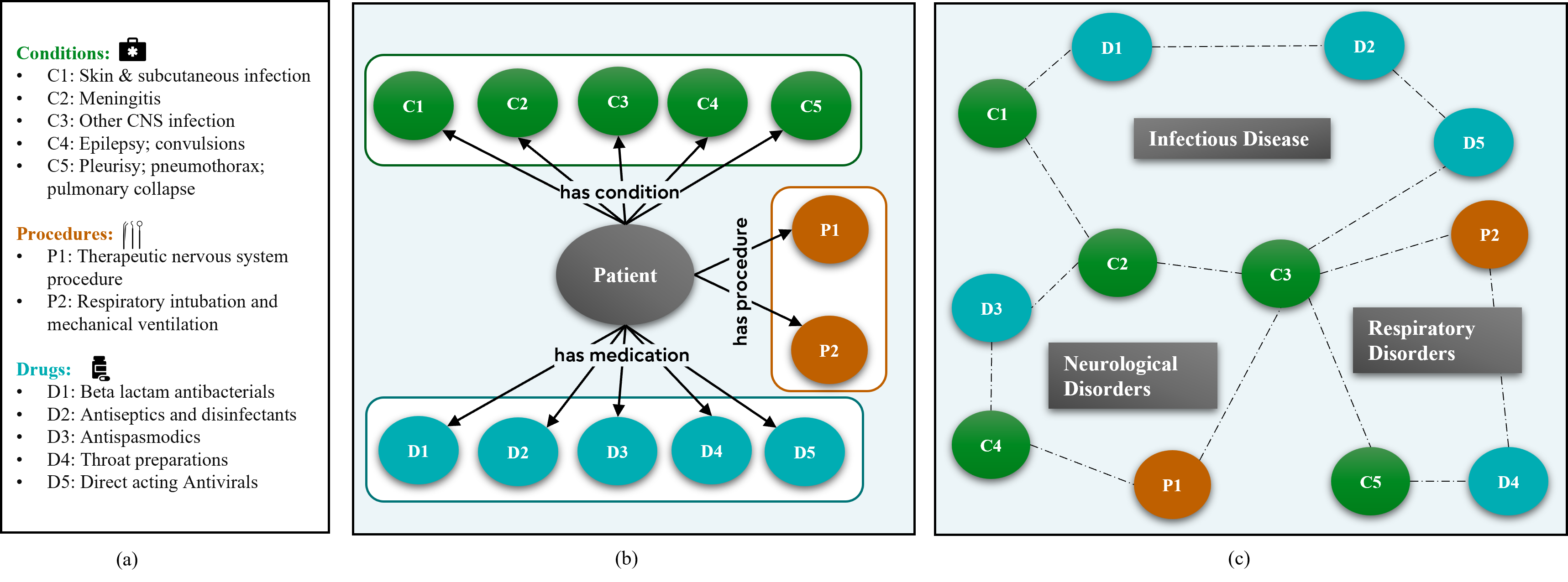
- 基于领域知识构建超边,保留每次就诊的临床上下文。
- 引入动态超图状态空间模型,显式捕捉患者状态随时间演化。
- 在MIMIC-III/IV上超越现有模型,适合重症预测等临床任务。
医学知识图谱(MKG)融合临床知识被广泛用于建模电子健康记录(EHR),以支持可解释的医疗预测。然而,现有方法难以捕捉临床概念间的成对关系,限制了对共现或语义相关概念的高阶交互建模。此外,多数基于MKG的表示学习方法要么忽略跨就诊的时序信息,要么缺乏对长程时序依赖的显式建模,而这对于死亡率预测等临床任务至关重要。为此,我们提出HoT-SSM,一种参数高效、面向高阶时序图推理的状态空间模型。针对每次就诊,该方法利用领域知识将语义相关的临床概念分组为超边,从而保留就诊级临床上下文;进一步,设计了一种新型动态超图状态空间模型,显式捕获患者潜在状态随时间的演化,并保持长程信息。所学表示用于下游临床预测与推理。在MIMIC-III和MIMIC-IV数据集上的实验表明,其性能显著优于当前最先进模型,验证了联合建模高阶临床交互与长程时序依赖的有效性。
原文摘要 · Abstract (English)
Medical knowledge graphs (MKGs) infused with clinical knowledge have been increasingly used to model electronic health records (EHRs) to support interpretable predictions in healthcare domain. However, existing MKG-based approaches are limited in capturing pairwise relations between clinical concepts (e.g., conditions, procedures, and medications), and restricts their ability to model higher-order interactions among co-occurring or semantically related concepts. In addition, most representation learning methods that leverage MKGs either collapse temporal information across visits or lack an explicit mechanism for modeling long-range temporal dependencies, which is critical for clinical tasks such as mortality prediction. To mitigate these limitations, we propose HoT-SSM, a parameter efficient and higher-order temporal graph reasoning with state space models. For each visit, HoT-SSM constructs hypergraphs by grouping semantically related clinical concepts into hyperedges using domain knowledge, thereby preserving visit-level clinical context. Further, to model the temporal dynamics while learning the representations, we introduce a novel dynamic hypergraph-based state space model that explicitly captures patients latent state evolution over time while preserving long-range information. The learned representations are used for downstream clinical prediction and reasoning. Experiments on MIMIC-III and MIMIC-IV datasets shows significant performance improvement over the current state-of-the-art models, demonstrating the effectiveness of jointly modeling higher-order clinical interactions and long-range temporal dependencies.
Thank you to arXiv for use of its open access interoperability. PaperDance 不是 arXiv 官方产品;中文卡片由大模型生成,请以原文为准。